Worlds & Time

Saturday, October 29, 2011

BestSFBooks Ranking System

So, since I'm sort of obsessed with Speculative Fiction awards (you may have noticed), my boyfriend emailed me a link the other day:


I took one look at it and decided that I have serious disagreements with the rankings generated by that site, although they generally do what I do, which is count various awards that books get and then rank them by the number of awards and nominations.

The first issue that I have with their method of ranking is that they count the wins and the nominations at the same value. Which has some merit, I admit. I also maintain a straight count of nominations and wins counted as "1" each. You can look at that and get a 2 vs. a 6 and generally tell that if that first book has two wins and the second book has six nominations, that second book is probably more widely liked among a general audience.

But I also maintain a "weighted" score which provides me with a different look: where wins are worth 1 and nominations are worth .5. A book with three wins should have a higher ranking than a book with 3 nominations or even a book with 5 nominations. And so you can easily differentiate in that way between the big winners and the big nominations.

If you're looking for a list of the best speculative fiction, I don't think the straight number of awards gets you to that book. The BestSFBooks site gives second place over the last 3 years to Anathema and The Dervish House each with a count of 7. But The Dervish House has 4 wins and Anathema has 3. If you're looking for an actual ranking of the books, then I would rank Dervish House higher than Anathema, although I would still rate Anathema higher than a book that got 3 wins and two nominations (like Blackout).

The second quibble that I have with their rankings is that they're weighted toward British Books.

Several of the awards that they rank are international. Hugo Awards, Locus SF/Fantasy Awards, John W. Campbell Awards, and World Fantasy Award are (as far as I can determine) all open to books published anywhere in the world. Hugo Awards are explicitly open to books in any language, although the general voting membership is English speaking and I don't think a non-English book has ever made the shortlist.

But BestSFBooks also lists the British Fantasy Society Award, British Science Fiction Association Award, and the Arthur C. Clarke Awards, all of which are only open to books published in the U.K.

Those Awards directly compare to only one strictly American award: the Nebula Award. And, while the American Nebula Award can go to either a science fiction or fantasy book, those categories are split out amongst two of the previously listed British awards, giving double weight and twice as many nominations to the British awards before even taking into account the Arthur C. Clarke excess.

There is one more American award on their list, the Philip K. Dick award, but the Philip K. Dick award can't be directly compared to the British awards, or even the other American awards. The Philip K. Dick award is specific to a subset of American speculative publishing: original paperback science fiction publications, which means that usually the awards go to books that aren't nominated in any of the rest of the categories. There are notable exceptions (Yarn, Nova Swing, The Devil's Advocate), but mostly the Philip K. Dick award targets an entirely different category or book than the other American science fiction awards do, so it doesn't tend to boost the numbers of awards from American authors. In fact, since the Philip K. Dick targets some books that are paperback reprints of British books, it can further inflate the number of wins or nominations of British works (such is the case with Nova Swing, for example).

So the top books on the recent lists are British, and there are a lot of British authors on top as well. This year, skipping the obvious winner of The Dervish House by Ian McDonald (sometimes the out-and-out winner is British, I have no quibble with that) there are two British books and two British authors on top of the first American in either category. Overall, there are five British books and five authors writing in the British scene on the top 10 award winning lists of the last year.

Over the last three years, you can see much of the same. Five of the site's best speculative fiction books are from British authors, but there is a shift as 6 of the top 10 "best" authors are writing for a primarily British audience as well.

Over ten years, the 10 best books have Americans in only three spaces. And there are only four Americans on the authors top 10 list.

All of this shouldn't be construed as implying that British science fiction authorship isn't enjoying a bit of a golden age at the moment, with authors like Mieville, Stross, Gaiman, McDonald and Clarke, but I do think that the way that BestSFBooks counts it's points skews toward British writers and books.

Third, I'm not sure that I would count the SFsite Reader's and Editor's choices as awards with the same weight as the Hugos, Nebulas, and Locus awards. Or even smaller awards like the Philip K. Dick. That's just a personal choice though, in the same way that I count the "big three" as the Hugo, Nebula, and Locus awards (I freely admit my Amerocentrism, and my list is primarily for me) despite the John W. Campbell awards' claims.

Fourth, and I agree that this is a bit quibbly with regard to a website called BestSFBooks, but they're really doing a disservice leaving off all of the rest of the categories beyond novel. There are some amazing short stories out there, and there are plenty of novellas that get limited publication as their own books. Heads by Greg Bear jumps instantly to mind.

Finally, i wish they had an "all-time" option. There are lots of great older books that could easily rank against more recent books if BestSFBooks gave them the chance to compete. Let's see some Ursula K. Le Guin toward the top.

Kudos to them for maintaining a usable, clear and professional site though. That isn't easy and they should be lauded for that.

Labels: , , ,

Sunday, August 21, 2011

Why isn't Connie Willis really famous?

So, one of my four favorite science fiction authors won another Hugo award yesterday. I haven't read her latest duet of novels, Black Out/All Clear, but I own them and they'll be read soon. Nearly everything that I've read by her has been brilliant though, even her book of science fiction Christmas stories (it works surprisingly well).

That Hugo Award win means that Connie Willis joins the tiny club of Robert Heinlein, Lois McMaster Bujold, Vernor Vinge and Isaac Asimov as the winner of more than two Hugo Awards for Best Novel, although Asimov and Heinlein have the slight asterisk of having won a retro Hugo (given for a year prior to the establishment of the Hugos in retrospect) among his honors. Bujold and Asmiov have four, and Vinge and Willis have three.

But that doesn't mean that she's just won three Hugo awards. She's won eleven total in all categories including short stories, novellas, and once for a novelette. All four major fiction categories. And she's won seven Nebula Awards, again in all four categories.

And there's the additional matter of the ten Locus awards, again in all four categories and the additional category of best collection (twice). Granted, she's missing the fantasy novel category at the Locus awards, but she was nominated once for it.

So, she's won all of the major science fiction awards, in all twelve of the categories that they have for them (and a Locus thirteenth).

Asimov was writing before and while the three major categories of awards here were being formed. His Foundation series, which is still brilliant, missed the start of the Nebula and Locus awards by more than ten and twenty years respectively, but did win the previously mentioned retro Hugo award for one of it's sections, and a special Hugo (ish*) award for "Best all-time series." Overall, he still won 6 normal Hugos (missed the novella category), 2 special Hugos, 2 Nebulas (for novel and novelette), and 7 Locus awards (again, no award for novellas but he did win for Nonfiction [twice] and for anthology). Were you to weight those wins the same, that's 17 major wins across his lifetime.

Bujold is next. She's won those four Hugo awards for novels but only one other Hugo category, novella for The Mountains of Mourning. Bujold also has 3 Nebula awards, two novels and a novella (again for The Mountains of Mourning). She also has three Locus award wins, two for science fiction novels and once for fantasy novel (the locus splits those two up). That's eleven total.

Heinlein, similar to Asimov, was writing before the major awards were completely established, and I actually suspect this hurt him more than Asimov. He's got those four Hugo awards for best novel, one retro Hugo, and one retro Novella Hugo for a total of six. Unfortunately, he doesn't have any Nebula awards, but again, they started late and he finished rather early, although he was still nominated for best novel four different times. He does have two Locus awards, once for Job: A Comedy of Justice (fantasy novel) and a nonfiction book. So that's only eight total.

Vernor Vinge, whose work I also love, has five Hugo award in total. Three of his Hugo awards are for best novel, and two are for novella. He also has no Nebula awards (that just amazes me, actually) even though unlike Heinlein he began writing after the start of these awards. He also has two Locus awards, one for novel and one for novella (The Cookie Monster, great story, I highly recommend it). That's only six major wins across the three major science fiction awards that I'm tracking here.

Before I get back around to Connie Willis, I'm going to throw two other names out there that are required on this list: the first is Ursula K. Le Guin. She's won an astonishing number of awards. Like Connie Willis, she's won all four of the major Hugo categories (and she was the first woman to win for best novel), plus a second Hugo award for best novel for a total of five Hugos. She's won six Nebula awards (four novels, one short story, one novelette). And get this, she's won twenty-one Locus Awards in basically everything that you can possibly win, all five of the major categories (sf novel and fantasy novel, novella, novelette, short story) plus nonfiction, plus collections (five of them). And, just to make this complicated, she's also won two World Fantasy Awards, one for best novella and novel, too. That's 32 major wins without the two WFAs, and 34 with.

The second is Neil Gaiman. He's won four Hugos, with two novels and a novella and short story. He's won two Nebulas, one each for novel and novella. And he's won 15 Locus awards, including being the only person on the list to win for the Locus best YA novel category (he's won it twice) although like Asimov he doesn't have one in the Novella category. Gaiman, like Le Guin, has also won a World Fantasy Award, although in his case it's for short story. That's 22 major wins with the WFA, and 21 without.

So let's get around back to Connie Willis. As I pointed out, she's won those eleven Hugos, seven Nebulas, and ten Locus awards. That's 28 major award wins. 28 major award wins including just about every major science fiction category and major novel wins. Doomsday Book won all three major science fiction awards for best novel, incidentally.

So, as far as this little survey goes, Connie Willis is the second most award winning science fiction/fantasy author in English, trailing Ursula K. Le Guin by four or six wins depending on how you count. And she leads Neil Gaiman, Vernor Vinge, Isaac Asimov and Robert Heinlein by sizable margins. And, if this wasn't already clear she's the only person, ever, to dual win both the Hugo and the Nebula award in every single category.

And tonight, the day after she won her 28th major award, we had some friends over for dinner. We talked science fiction for a bit and I recommended Connie Willis. And despite being a consistent reader of science fiction, he'd never heard of her before. We would have loaned him a copy of To Say Nothing of the Dog on the spot, but apparently we've already lent it out. That still staggers me. She's one of the most award winning science fiction writers of all time, and she's still completely unknown, even among many devoted science fiction fans.

Why isn't Connie Willis really famous? I just don't understand.


* Just to be clear, the best all-time series was a special Worldcon award, but since the Hugo rules apparently allows the Worldcon to tack on awards, I'm not exactly sure why it isn't explicitly a Hugo award.

Labels: , , ,

Monday, July 05, 2010

NetGalley and Carina Press

So, through something I have to deal with at work, I found the website "NetGalley" which allows you to request eARCs (electronic advance reader copy(s)). Basically, you can get a digital copy of a book to read or review before the actual book comes out in stores.

The Neil Gaiman edited Best American Comics 2010 is on there, which is pretty cool. There's also a version of the Little Prince as a graphic novel. But I don't expect those things really need my attention to sell them. Neil Gaiman and The Little Prince are both brands that aren't going to be helped by a relatively minor blog review. And I'm not really interested in either of them enough to want to request them.

But I do get some blog traffic around both my comments on gay porn and science fiction fantasy. So I was especially interested to find that there was a novel listed that actually fit into that niche: Savage Sanctuary by Jacqueline Barbary. I requested that one and another one that Carina Press publishes, Life After Joe by Harper Fox.

Both were denied, which was too bad. I wouldn't have bought either of them, especially from an unknown press. It's not the loss of a sale for them. Really, the best that could have happened was that I liked them an gave them a favorable review. Well, won't bother now.

So, I guess the whole point of this post is: what's the point of NetGalley if you can't get galleys from it? If you're wondering whether to bother signing up (and they ask you for a lot of personal information, including your real address and phone number), I would say no.

Labels: , , ,

Wednesday, October 14, 2009

Muad'Dib! The Musical

Just for fun, I added some entries into Scalzi's little writing contest over at his AMC column. This is the only one that I didn't think was quite up to the contest standards, so I guess I'll post it here. You can see the others in the comments at the column.

Despite the angelic singing voice of Hugh Jackman, the latest screen version of the novel Dune, Muad'Dib! The Musical suffers from many of the problems that have plagued past adaptations as well as adding a host of new ones.

From the beginning some vocal critiques in the fan community have criticized the role of Paul being given to Jackman, but he does not feel quite as out of place as some more egregiously miscast members such as Fantasia Barrino as the Reverend Mother and Kenny Chesney as Duke Leto Atreides. Despite the many new action sequences the plot slithers along painfully when faced with a cast that seems to realize that this latest installment isn’t going to provide much momentum for their stalling careers. Even Jackman himself seems to react woodenly against with Chesney and his nameless love interest played by the disinterested Renee Zellweger.

Further, technical problems plague the many special effects, probably due to the rushed post-production schedule. If you are least hoping for a Star Wars like bonanza, prepare to be disappointed by flat looking backgrounds and positively uninspired art direction. Universal apparently believes that musicals no longer require any visual stimulation to carry them through.

Overall, you’re better served seeing one of the other musicals adapted from science fiction properties playing currently, Star Trek: The Next Tango or Babylon 6: Musical Disarmament.


I like my first entry particularly, so after the winners are announced, I'll probably repost that one (or perhaps all of them) here.

Labels: ,

Tuesday, June 30, 2009

Heads by Greg Bear

I just finished the Novella "Heads" by Greg Bear.

It was pretty good, the characterization could have been better and the end was sort of predictable but it had me worrying there for a while.

You see, it's been a while since I picked it up from the bookstore. Even then all I knew about it was that it was a Hugo winner. If I knew anything more than that about it, I'd forgotten it so it was a blank slate to me.

As I was headed into the last few pages (*cough*) I couldn't tell if it was going to be a ringing endorsement of Scientology or a scathing denouncement.

It is definitely about Scientology though. It's so thinly veiled that it's beyond gauzy and into the realm of body paint. Thierry is Hubbard.

I don't know much about Greg Bear. He could have been a convert, for all I know. He could have had some other reason to want to ingratiate himself with the Church or want to support them.

But he didn't. Instead, he shows in a novella why Hubbard should be disregarded. It might be a fictional work, but so's Dianetics.

Labels: , ,

Monday, June 08, 2009

Noird and Sushi

On June 3 in Cambridge I got to hear China Miéville speak about his new book The City and The City, during which he let fly with the created word "noird." He was content to let it live in the wild: he refused to define it himself except for in the most general terms and refused to speculate on other authors that it may describe. (If you're interested, the first reference to it is here and Why Mice Sing delves into it here.)

During the signing, he told me that I should spread #noird, so I guess I'll have to go sign up for Twitter. China Miéville told me too.

I asked Ben to talk about his thoughts about noird, because he's substantially brighter than I am and more apt to clearly express interesting ideas. He said:

I went to see China Mieville give a reading and question and answer session last week, in which he declared that his most recent book 'The City and the City' is a member of the noir and new weird portmanteau: noird subgenre. Upon declaring this new subgenre, Mieville started the question and answer session. I fired off the first question: 'Who else would you put in the subgenre of Noird? For me, Richard K Morgan immediately springs to mind, but what do you think?' Mieville demurred and suggesting that we need to identify the authors for ourselves. To wit, I start with a modest proposal for what Mieville is defining.

Noird is a fusion of Noir and New Weird - Noir is fairly straightforward: hard-boiled detective/crime/police procedural story - I always thing of Raymond Chandler and Chinatown. New Weird is a bit more amorphous - presumably, this encompasses the new science fiction approaches, the speculative fiction which Neal Stephenson defines so cleanly here. There is certainly a current/modern component to this, so Golden and Silver Age of sci-fi/fantasy should probably be excluded.

On the author/book list (as Mieville implied that not all his work is Noird, but 'The City and the City' most certainly is) I suggest the following:

  • Takeshi Kovacs (Altered Carbon, Broken Angels, Woken Furies) series by Richard K. Morgan
  • The Yiddish Policeman's Union by Michael Chabon
  • Something by Neil Gaiman [not sure what, but he's certainly New Weird, and there's got to be detective elements to some of what he's done]
  • Thursday Next series by Jasper Fforde
  • Halting State by Charles Stross [possible others like Glasshouse have references along those lines]
  • The da Vinci Code/Angels and Demons by Dan Brown [possibly too mainstream to be new weird, but there's certainly elements that map onto this construct - stylistically, the noir component falls short here--there's not a lot of that hard-boiled feeling]
  • Hard-boiled Wonderland and the End of the World by Haruki Murakami [though others from Murakami fits into this as well]
In many ways, I feel like Philip K Dick was a major founding influence in this Noird genre - looking at works such as Do Androids Dream, A Scanner Darkly, which wiki calls "a bleak mixture of science fiction and police procedural novels;" possibly may be the founding work. That being said, Alfred Bester's The Demolished Man is a worthy contender as well, with the heavy influence of the classic Noir style.

Obviously, there are other and further choices, but this is certainly a reasonable sub-genre which captures many works which sort of defy classification.

Personally, I'm not convinced that when Ben wrote this, his definition of New Weird was correct. I asked if he'd looked New Weird up on Wikipedia and found that he hadn't. Some of the works that Ben takes for granted as New Weird aren't necessarily part of that movement and some of them predate it by decades.

So, New Weird "subverts the romanticized ideas about place found in traditional fantasy" and invents complex and believable worlds in which the plots are set in a more realistic and not particularly utopian setting. Basically it's fantasy set in a world that extends beyond the boundaries of the story that exhibits the traits of the real world.

Jonathan Strange & Mr. Norrell is on the Library Thing list above and both Ben and I agree that it deserves it's place on that list. Ben, having just finished the Chalion series by Bujold, thinks that those books belong to that movement as well and I can't necessarily disagree. I would add George R. R. Martin's ASOIAF to the movement as well. His books are subversions of a romanticized fantasy setting.

Possibly Harry Potter by J. Rowling belongs to this movement as well. It's certainly an expansive world that belongs to a world with a past and future that exists regardless of the actions of Harry. It does push the limit on the "realistic" front though, although I would argue that the later books show that the world in which Harry lives is not the typical utopian fantasy setting. The Minister of Magic is voted out, isn't he? Characters related to the main characters die. Not everyone lives happily ever after and if we're defining this movement by expansive worlds and a step away from utopianism, then I would argue that it does fit.

Ben would point out somewhere in here that J. Rowling would never describe herself as "New Weird." Considering her separation from the mainline fantasy movement I would question though whether she'd even accept the term "fantasy," so why does it matter?

It matters because China is spreading New Weird himself, as sort of a self-promotional/sales technique. That doesn't mean that it isn't a valid sub-sub-genre but it does make me question how correct the pushed definition is to the way that people use it. And since Noird is a sub-category of New Weird, how specific are we willing to get?

There are only a few examples of Noird, but Ben feels (and I would agree) that the are categorical, there are ways to parse out the differences between New Weird and Noird. Figuring out what those were led me to at least one more subset that Noird must be distinct from: Victorianeird (pronouced with a hard e at the end).

Victorianeird is that part of the New Weird that adapts the literary conventions, styles and sometimes setting and characters of Victorian England. Jonathan Strange & Mr. Norrell is the obvious genre defining work, but there are others. Brust's Viscount of Adrilankha series is probably another. Although I haven't read them I would guess that Pride and Prejudice and Zombies by Seth Graham-Smith (and Jane Austen, of course), the Temeraire series by Naomi Novik probably fit into that category as well.

So yeah, Noird and Victorianeird. If I have any more thoughts, I'll have to do a follow-up post.

Moving on to the sushi part of this post: Cafe Sushi on Mass Ave in Cambridge is excellent. Really, really good. I guess they've changed management recently but they're much better now than they used to be. So, if you happen to be looking for excellent sushi in the Cambridge area, I heartily recommend them.

Labels: , , , ,

Thursday, May 28, 2009

Julian Comstock by Robert Charles Wilson

Written October 8, 2008 while I waited for the book to get published:

I got lucky again. I stopped by Tor when I got to New York to drop off a get well soon card for Teresa Nielsen Hayden. Patrick just happened to be there and he offered me a free book.

You should have seen my face light up.

The problem was, I was still staying with Jay at this point, and everything I owned was in two suitcases and a backpack, all stuffed to the point of bulging seams. I had nowhere to put another book, not even a free one.

But he popped back into his office and came back with an ARC, an advance reader copy, of book by Hugo Award winner Robert Charles Wilson. I'd already read Spin and I happened to have the sequel Axis in my backpack. (PNH pointed out that the final novel in the trilogy, Vortex, is currently being written.)

A free book I could turn down, but this was more than a free book. It was . . . special? Using that word seems forced and it implies things that I don't intend but it still comes closest to conveying what I'm trying to get at. I like having connections with the books I read. I like reading signed copies, I like reading books by friends or acquaintances. And I like advance copies.

This is supposed to be a review though, so I suppose I'll move on to the book.

Spoilers Galore

Julian Comstock: A Story of the 22nd Century by Robert Charles Wilson is a future history. That is, it's a novel about the future written from the perspective of someone that is recalling it as history. In this case it's a biography of Julian Comstock by his good friend Adam Hazzard.

Julian is the nephew of the President of the United States, Deklan Comstock, and the presidency has become something of a monarchy. There are still elections but there are little more than a formality. Senate seats have become hereditary. Still, things are not quite stable. Julian's father is declared a traitor and executed when he starts to rival his brother's popularity and Julian is sent away to what used to be Canada for protection from his uncle (I'm pretty sure that the place where he grows up, William's Ford in the Athabasca region of Alberta, is a reference to William Gibson who went to Athabasca University, but tons of the references went flying over my head so I may have gotten this completely wrong).

Adam's mother works at the Comstock estate and eventually Adam and Julian become friends and so when Julian is forced to leave home due to the machinations of his Uncle, Adam leaves with him.

This isn't the stereotypical science fiction novel. Instead of living in world where technology has progressed the characters live in a world that is much more like the late 18th century that the 21st. Oil has Effloresced, and combined with plagues and "the false Tribulation" the world has returned to what we would consider simpler times: horse drawn carriages and ships are the primary forms of transport, digital technology is lost, and conservative Christianity has fufilled its Dominionist dreams and taken over most people's daily lives and infiltrated the government. The sector of power that they've created is even referred to as the "Dominion" and is based in Colorado Springs.

Since this does take place in the future though, it's interesting to see what has been made of past by people that have trouble believing in things like cars, traveling to the moon, or flying to Europe in eight hours.

This is in some sense a bildungroman, and I suspect that aside from the modern in jokes it would have fit in well with literature from the 18th century. The level of technology, the overt Christianity and the greater emphasis on propriety and decorum through the reassertion of conservative value systems over an entire society are all more closely related to Gone With the Wind than 1984.

As such, this isn't the sort of book that I'd normally read. I like space ships and aliens and computers and that sort of thing, and I probably wouldn't have picked it up off a self as something that was required reading. However, I can say that it was engaging, entertaining and well-written.

The characters are for the most part three dimensional, especially Adam as narrator and Sam Godwin the Jewish bodyguard of Julian (I suspect his name is another subtle joking reference, this time to the internet meme). The plot is believable, and the setting is beautifully described from Alberta to British Columbia to New York City.

In order to do an honest critique, the rest of the review contains even more spoilers. Unless you've already read this book, aren't planning on reading it, or don't care about spoilers stop reading here.

My main quibble with the books is from one major element that is clearly implied in nearly every chapter of the book about Julian but isn't ever directly addressed. He's gay. There are several major jokes based on this throughout the novel, including one in the last few pages that is intended to endear the audience to Adam.

Trying to rationalize this from an authors perspective, I have problems coming up with something that I would agree justifies this. First, it's implied at the end that Adam never figures this out. On the contrary, several people have suggested this directly to him and he says as much in the first chapter. So he seems to have considered it and dismissed it.

Second, if Adam had attempted to hide his friend's sexual orientation, there are sections that would be differently written or completely left out. Considering that he describes the book as "a true and authentic portrait of [...] Julian Comstock" and in every other manner seems to hold to this seem to suggest that Adam didn't intentionally cover it up, he just didn't consider it.

But this doesn't make any sense. Considering Adam's issues with Christianity, he never shows discomfort with his friend's presence. Pardon my language, but bull crap. Given his reaction to finding out that Godwin is a Jew, he should have a significant discomfort or insecurity or curiosity about homosexuality and there is absolutely no justification for why he doesn't.

So, as a twenty first book written by a person writing as another, I have to ask: What the crap is so special about homosexuality that it's danced around?

It's obviously relevant to the story. Chekov's gun. But why write around it and pretend that it's not there? To be honest, this significantly bothers me to a large degree. Our society currently has enough problems being forthright about homosexuality. Look at Clay Aiken, who just came out of the closet (and Adam Lambert, who hasn't -- ST May, 2009), not to mention Ted Haggard and hundreds of others.

It can't pretend to address this though, because it's never explicitly addressed. It would be like writing a book in which one of the characters is implied to be Jewish and then claiming that it addresses the way that Jews pass in modern society. No. If the problem is that gay people can't be open or honest then a book that isn't honest is part of the problem, not part of the solution.

And it is a problem. Do you know how many (human) homosexual characters I can think of in science fiction? Maybe ten, and almost all of them are minor characters. If I want to identify with a romantic situation in a science fiction book, I usually have to pretend that I'm the girl, or that the text says "he" instead of "she."

So here you have a central character (his name is on the cover, notice) that's gay. Julian is already a rebel in a situation where homosexuality is a crime and the most homophobic sections of our society have become the law of the land. Further, this is a book about how the character becomes a man and learns about life. What better situation is there to write about a gay character dealing with homosexuality in a world of conservative Christianity?

So why isn't a major part of his life addressed?

At some point I feel that I'm blowing this out of proportion but I can't emphasize how empty I felt at the end of the book when I got to the big homosexuality joke about men and their wives. Usually I can just laugh this stuff off, but this particular point has been festering for a couple of weeks now. I'm used to comments like the end joke from people that deride homosexuality, I guess I just don't feel like I need to take it from someone that is comfortable with gay people.

Yarg. Now it sounds like I didn't like this book. I did. I thought it was great. I enjoyed reading it, and carried it around the NYC subway with me for days, marveling at the Wilson's amazing ability to take us back and forward in time at once. I just had an issue with that one specific little part of it.

Anyway, despite the issues that I had with it, I recommend it, especially if you tend to like 17th and 18th century historicals or historical fantasies.

It's available for pre-order through Amazon here.

Labels: , , ,

Friday, April 24, 2009

OSC Joins NOM

I don't usually offer responses on news stories. I figure that you've probably gotten your fill from the bajillion other sources out there. I do, so presumably you have your choice sites like Digg and Fark and GoogleNews that hunt down and tag stories for your pleasant engorgement.

I did almost miss this, for the most part though. Orson Scott Card is now on the board of the National Organization for Marriage, which is that group that created the oft mocked "Gathering Storm" video.

That doesn't surprise me, really. OSC's views on gay marriage are fairly well known. He's Mormon, after all, and he has that long running column over in the Mormon Times where his opinion has been made explicitly clear.

My first reaction to all of this was almost instinctual at this point: I remind myself that there's a reason that I don't buy his books new any more. Granted, it was Empire that spurred that more than his politics but the revelation of his beliefs certainly provided that last little FU that kept me from turning back.

Buying them used is fine, of course. No money goes to him or his publisher from that.

Then I reminded myself that it doesn't really matter whether I buy his books. He's trying to get a movie made of Ender's Game and Ender's Shadow and he's going to be filthy rich and tithing loads of cash to an organization that hates me anyway.

But the movie has been floating around and hasn't been made yet. It's always in the works but never in production, seemingly.

Using this neat little writer's trick I learned somewhere, I imagined that I was a cappucino and coke snorting secular capitalist movie producer drone. Would I, as aforementioned mindless drone, want to make this movie still? Yeah, the book won some awards that I'm not familiar with and all my assistants assure me that it has a huge following but I also know that if I make this movie now I'm probably going to have to end up explaining to the gay director, star, and four fifths of the production staff why this author's position on gay marriage is not reflected by the production company.

With all of the crap that's been thrown, sometimes litterally, at the Mormons over Prop 8, there could even be protests. Protests with A-list stars speaking out against this movie just because author is in the news right now.

So, even though this property may eventually make me, the cappucino and coke snorting mindless secular capitalist movie producer drone, lots of money in the future, right now it would probably be a good time to quietly renew the movie rights and hope that gay marriage is decided soon so that this author can market his work for us rather than against us.

(Just found this, might be interesting to some)

Labels: , , ,

Friday, April 03, 2009

1111 Books

So, today I picked up a few books at a science fiction used book sale and after putting them in my incredibly geeky spreadsheet I discovered that I have one thousand, one hundred and eleven books. I'm not a numerologist, but it's still very pretty to look at so I decided to write a bit about it here.

If you want to know what books I have specifically, you can check them out over at library thing, which I've kept updated. However, it is missing a few text books and obscure books so the library thing count is only 1065.

Because of the obsessively anal way that I keep track of my books, I have a bit more statistics than even appear in my library thing profile. Especially since I don't use library thing to keep track of which books I've read or not.

Here are some random numbers that should be as boring as all get out to anyone else:

Of those 1111 books, I've read 575 or 52%. Some of those volumes contain more than one book, and if you count those, I've read 685.

732 of those books are paperback, 187 are trade paperback, and 146 are hardcover. 46 are textbook sized or larger. 30 are signed (13 are just signed, 13 are personalized, and 4 are personalized first edition hardcovers).

The best represented publisher is TOR/ORB with 144 books. In second place is Del Rey with 121. Third is a near tie between ACE (88) and Bantam (87).

444 of those books are fantasy and 519 are science fiction. Altogether my speculative/strange/sf/f collection is 989 books. Interestingly, while the ratio of fantasy to science fiction is around 77/90 I've read a lot more fantasy. The ratio of sci-fi to fantasy that I've actually read is around 41/73.

The average number of pages per book is 384, the median is 339. I've read 197,440 pages of fiction in my library and I have 166,443 to go. The total number of pages is 427,013. I would guess that the average words per book is around 86,479. That means I've probably read about 44, 424,000 words from the books I own.

My collection contains 168 Hugo Award nominees and 48 Hugo winners. It also contains 84 Nebula Award nominees and 34 Nebula winners. 15 have won both awards. I've read 31 of the Hugo winners and 19 of the Nebula winners (but as I mentioned, 15 of those have won both award). I've also read 40 of the Hugo nominees and 33 of the Nebula nominees.

I also track the Locus Award, John W. Campbell Memorial Award for Best Science Fiction Novel, World Fantasy Award, James Tiptree Jr. Award, Gaylactic Spectrum Award, and Lambda Literary Award. Usually good books will collect more than one award, so of 1111 books, 307 have won or been nominated for one or more of these awards. Of those, I've read 104, or around 34%.

If you were me, you'd be wondering what the most honored book in my little library is. Well, that depends. If you just go counting awards and nominations then China Mountain Zhang by Maureen McHugh is by far the top with six. It was nominated for the Hugo and Nebula, won the Locus for best first novel, the Tiptree and Lambda Litterary and garnered special recognition from the Gaylactic Spectrum folk.

If your a writer and you ever wonder if anyone has sold a novel through the slush pile, then be aware that during a Boskone panel, the editor of China Mountain Zhang pointed out that it was a slush pile submission. Also, if you've never read it and you like exceedingly intellectual science fiction, then I highly recommend it as one of the best novels that I've ever read.

You'll notice that it only was nominated for the Hugo and the Nebula though, so you're probably also wondering what the biggest winner is, then I have a way of weighting books as well. I give a point for a win and a half point for a nomination (actually, it's more complicated than that, but I don't feel like explaining right now). If looked at that way then Shadow & Claw, the first half of the Book of the New Sun by Gene Wolfe is ranked highest. This is a omnibus edition of Shadow of the Torturer and Claw of the Conciliator. Between these two books this volume has one Hugo nomination, one Nebula win and one nomination, one Campbell nomination, one WFA win and one nomination and it won the Locus for best fantasy novel.

Alright, so what's the most recognized single volume work? Including the gay sci-fi awards, that's still China Mountain Zhang. If you discount those though, it's a tie between Rendezvous With Rama by Arthur C. Clarke and Gateway by Fredrick Pohl both of which achieved the quad win: Hugo, Nebula, Locus and Campbell.

Here's a few other weird things that I know about my collection. 83% of it is in boxes right now because of my move out east. For every movie on VHS or DVD that I own, I own 18 (almost 19) books. Finally, if I read a book per week, it would take me more than 13 years to get to the number of books read that I have. Which is actually a little embarassing to me, considering that I've been reading novels a lot longer than that. It means that some weeks I've been slacking (or stuck on a particular book).

I have no idea why I so obsessively and compulsively keep track of my books. It's just this thing that I do, and sometimes it helps me keep track of things and sometimes it annoys the crap out of me (like just now, when I discovered that The Yiddish Policeman's Union by Michael Chabon did not win the Campbell and I had to go back and fix it and this post, grrrrr).

Labels: , ,

Thursday, February 26, 2009

Stross and Scalzi Are Wrong

Right now there are five blogs by authors that I heavily follow right now: Scalzi, Stross, Wheaton, Gaiman and Duncan. While there are a lot of other authors that I like that have blogs, those are the blogs that I find interesting in and of themselves and post updates regularly enough for me to keep track of them on a regular basis.

The other thing is that I usually agree with them on stuff.

Not on everything, true, but often. And when I do disagree with them, it's usually an issue of personal taste.

The last couple of weeks though, the science fiction annex to the blogosphere has been a place where I can't seem to find a position that I agree with (excepting the dust up about the Kindle2 text to voice thing).

That GRRM thing though? I didn't even have to go read what GRRM said before I knew I vehemently disagreed with Scazli and Stross about it.

Yeah, people were rude. And they were bugging him (and, personal confession here, I bugged him about it one time in person under the mistaken impression that he'd find it funny. I apologized at the time, but I don't think he believed me).

But there are a lot of circumstances around what GRRM did that make Scalzi and Stross just plain wrong about what they said. Dealing with upset fans who you've misled (inadvertantly or not) is one of those things that you will have to do if you are a popular writer with lots of fans who has decided to provide easy access to himself online.

Further, there's been a huge kerfluffle about other stuff. Which I am not going to talk about. And do you know why? Because it scares me to talk about it here.

That's saying a lot. I've talked about being gay here without reservation. I've talked about being an atheist. I've talked about my problems with jobs. I've talked about being depressed and all sorts of other stuff without much regard for boundary. But there are very few subjects which I will not discuss out of fear.

Sides are being taken. People are angry. And while I have an opinion on the subject it's obvious at this point that it would be detrimental to my future plans to express it.

It's not my opinion that would get me in trouble. In fact, I've talked about this subject in previous posts. It's being involved that is a bad thing right now. Your associations are being held against you in a way that is making me uneasy.

I know how paranoid that sounds, but I've seen how far some of the people arguing are willing to take themselves and it's too far. These are people that I thought would be serious and reasonable but they're seriously unreasonable instead.

As such, I'm not going there, nor am I going to link to it or cite any of the participants by name because I don't want to associate myself and I know how easy it is to follow a link back to it's source.

Labels: , ,

Wednesday, November 12, 2008

Connie Willis Musings

Connie Willis is a freaking genius. I think that's three of four books that have left me crying, and the only reason that I don't think it was four for four was that the first one I read was sort of a comedy.

Bellwether was the first book that I read (I had it lying around in a stack of books that I didn't intend to read and then noticed that the author was the same as some of the ones on my "Award Winners" buy list, and it's the book that I now recommend to my scientist friends because to me, a non-scientist, it seems like the closest that I think I will ever come to understanding the life of a scientist. When B. talks about his work I flash to that book.

It was funny too, with the few sensible characters in a world of madness that's a theme of Willis'. In the strictest of senses, it wasn't so much science fiction as it was fiction involving scientists. There's the problem with that tag; it's impossible to differentiate between the genre and the latter with those words without a sentence to explain.

And then I read Doomsday Book, which left me crying for the sheer overwhelming pain expressed therein. I mean, really, it's been years since I can remember crying at the end of the novel. I think I cried at the end of The Dark Is Rising sequence and I may have cried at something that David Eddings wrote, but in recent years there aren't many books that I can point to as tearjerkers.

Doomsday Book won the Hugo, Locus and the Nebula awards and it deserved them. Indisputably, in my opinion. It was a work of art and it's one of the reasons that I think that relegating genre to the back of the bookstore is freaking criminal.

And then I read To Say Nothing Of The Dog . . . ah. I forgot To Say Nothing Of The Dog in my count in the second sentence. I didn't cry at the end of that one, but that doesn't reduce the number of Connie Willis books that I've cried at down to two. Now that I think of it, the real number is five, two that I haven't cried at and three that I have.

To Say Nothing Of The Dog is another one of those books that I saw labeled as science fiction comedy but I can't remember where I saw that. And it's not really laugh out loud ha-ha comedy like Asprin's Phule and M.Y.T.H. Inc. books or Douglas Adams' Hitchhikers Guide or Terry Pratchett's Discworld. In a sense it's a bit comedic and I guess it could be considered to be funny, but it's more of a comedy of errors, where the character of the father is played by the space/time continuum. All sorts of little strings come together to get the lead man to come together with the lead woman and it really revolves more around the cat than the dog.

Those two books, read in succession, are what convinced me that Connie Willis was British. People write what they know and both Doomsday Book and To Say Nothing Of The Dog are set in England (always a good place to base time travel). They also convinced me that sometimes the books that win Hugo's or Nebula's are not only technically very well written but they're absorbing as all hell.

Just before I left, I guess this would have been in late August or early September, I went to Bubonicon, where I got to hang out with Steve Gould and Laura J. Mixon a bit. I also discovered that the Sci-Fi retailer down from Boulder (I'm sure I've got one of their cards around somewhere, but I don't remember their name) had a stack of Connie Willis books signed because she was actually from Colorado and apparently will sign just about anything that you stick in front of her. So I bought five signed books from them and my only regret is that I didn't buy more, such as signed copies of the books that I already had. I just tell myself though that maybe I'll be able to get my already purchased copies signed and maybe even personalized someday. There's a huge hardcover and I'm seriously thinking about buying it the next time I see it, regardless of its $40+ price. It's worth it. Or I bet it will be.

So then I read Passage by Willis and It seemed like one of her earlier works (although without the internet I have absolutely no idea if it's one of her earliest works or latest works, or possibly even middle of the career works. The characters didn't seem as polished and the plot seemed to struggle at time (that's the problem with comedic plots: if you don't play them just right the constant stream of misunderstandings and he said/she said and walking past each other can get old fast.

I kept thinking of Doomsday Book as I read Passage though. It had echoes of it, with the heavy themes and the constant treatment of death but I kept telling myself that it was different, that I wouldn't cry at the end.

Mrs. Willis made a liar out of me.

Doomsday Book and Passage are sad. Technically, Doomsday Book even has a bit of a happy ending but at the same time they drag you down and point to something sad and say "grok" and you're forced to do so. That's impressive in any genre.

The last one, the one that I just finished as my third book for the day (finished Mother of Storms, read a cute gay fluffy mystery, and will start Zoe's Tale by Scalzi after I finish this post) was the novella Remake, which wasn't really sad. The water in my eyes was probably more something of joy than something of sadness. It was bittersweet at the end, but still hauntingly sad. Willis knows how to write damaged characters that don't know what they want in the same vein that I want to write.

She also knows how to write characters that want things. If you write what you know, that's something that I think I'd probably have trouble with.

She also researches her books into the ground. If I went back in time to look at the locations described in Doomsday Book and To Say Nothing Of The Dog I suspect that I would be able to recognize them without too much trouble . . . those that can be researched in the 20th and 21st centuries that is. Bellwether, Passage and Remake were full of references to things that I know must have required hundreds of hours of research with a notebook. I can't even imagine what her notes look like though because sometimes I would see an offhand comment and think to myself that one line must have required dozens of hours of research by itself. How she planned everything at that detail out ahead of time so that she could read the medical journals and the histories and watch all those old movies marking out instances of alcohol, tobacco and drug use is beyond me.

If I was half the writer or researchers that Willis is, I think I'd be in a much better position with my life.

I have to wonder if she'd be interested in a cheap assistant, perhaps someone that she might be able to mould into a good writer. Yarg. I don't understand sometimes why apprenticeships are dead. Seems like a perfectly valid way to learn a trade to me.

Labels: , ,

Monday, November 10, 2008

Brain Simulation and Hacking

Happy Birthday Bro.

Spoilers for: Snow Crash by Neal Stephenson, Accelerando by Charles Stross, The Android's Dream by John Scalzi, the Otherland quartet by Tad Williams, and Mother of Storms by John Barnes.
Warning: Very Long.

I've been reading books recently in which the humans sometimes exist as simulated brains in simulated digital environments. Off the top of my head, this encompasses the Hyperion Cantos by Simmons, Accelerando by Stross, The Android's Dream by Scalzi, and the Otherland quartet by Williams.

In order of technological complexity those books are in reverse order and so the world in which Otherland is set has the most difficulty simulating the human mind, while in the AI universe of Simmons or the computronium of Stross the process is fairly easy.

There are a few problems with modeling the staggering complexity of the human mind that I haven't see addressed yet, and I'd like to consider that for a moment.

First, none of the books go through the painful phase in which a human mind has been adequately mapped but the computational power required to process even a few simulated moments takes a distributed computer network minutes to produce.

Let's consider The Android's Dream for a moment. Scalzi suggests that the only way to model a human brain is through a capture at the subatomic level, at the level where quantum uncertainty provides the unpredictable nature of human thought. Thus, the boys go in, scan themselves, and leave.

Years later, when the simulation of Brian Javna is compiled on a supercomputer the brain runs incredibly quickly. In fact, it turns into a super-program, able to rewrite, exploit, and interact with computers at a superhuman level.

Why would it run that fast though?

We're talking about a simulation of a human brain in which not only is the behavior of every electrical impulse through a brain is mapped, but the behavior of every molecule and atom in every molecule is accounted for.

To get some idea of how complicated this is, remember that the question of how proteins "fold" (i.e. how atoms fit together to create the complex organic molecules that form the building blocks of living creatures) requires huge distributed computing networks made up of thousands of machines. If you've got a PS3, you might be part of this effort through Folding@home.

To model the brain is worse. The chemicals that surround each neuron modify the electrical impulses of thought to provide memory and emotion. Which means that for every thought that occurs in your head not only do you have to account for the very complicated path that the thought travels through, but you have to know what molecules surround the path and what effect they'll have on the thought.

Neurons are connected in sequence, true, but not in direct linear or binary sequence either, which might have made it easier on the computer. If an electrical impulse has four potential paths in a human head the computer will have to attempt to figure out where it goes in binary questions (Does it travel through path one? No, so it continues on. Does it travel through path two? No, so it continues on. Does it travel through path three? No. Does it travel through path four? Yes, and now there are another four possibilities that need to be accounted for). This means that for the work that the neurons sitting in the grey goop on your head can do relatively easily, a computer has a much more complicated path to travel.

There are problems on the other side too: Assuming that the computer can accurately run the physical simulation of a human mind, how does it know what all those chemicals and impulses mean? So now the computer has to figure out what all of those slight changes mean in terms of mood, thought and memory and convert all that meaning into binary again so that the artificial human intelligence can express itself.

So I found that it strained credibility in my mind when the character in The Android's Dream woke up in a computer and found that he processed information faster than normal. In a world with binary electronic computers the electronic modeling of a human brain would require so much computer processing power that it's highly unlikely that it could be simulated as a whole without serious latency between sections.

I would have expected instead to find that the character woke up in a fog, in which part of his brain was simulated first, and then another part, and then another part, and then all melded together in stages as the computer struggles to process all that minutia. In the end, the artificial mind might think that it was alive, but each moment that passed for it would actually be several "real" moments.

Imagine what that would be like for the brain; you receive a stimulus, perhaps a bang. Instead of being able to flinch from the sound, it would require the computer program to figure out that you would want to flinch from the sound, and then figure out what your response would be . . . in sections. Instead of being able to access memories and parts of your mind all at once, your memories might lag behind your current thoughts for a moment while the computer struggled with a particularly complex chemical reaction, or vice versa.

That previous paragraph is a bit vague so let me try to lay this out even more clearly. If the sound I mentioned before were a voice instead of a bang, the computer program would have to figure out how the voice affected the ear, which in turn affected the auditory nerve, which in turn would communicate with the brain. The brain would access voice and try to interpret it by accessing memory of voice, and so the computer would have to track each of the chemicals as the memories were accessed and then back as the voice was decoded. Each of these would be processed separately, and so would your reaction to it.

Do you know what it feels like to realize that different sections of your brain are operating at different speeds? I can't imagine that the feeling is pleasant.

So, to hide the fact that your brain is running at different speeds, the computer simulation will have to slow the entire process down to the lowest common denominator. For something that's already running slowly, this is only more time passing that the computer simulated brain can't work with.

The end result is that not only do you have a mind in a fog, you have a mind running very slowly until you have nearly incomprehensibly fast computers, and elegantly written simulations to run on them. I'm not a computer guy, but I suspect that this is currently beyond the horizon in any form, even assuming that Moore's Law holds up for the next twenty years.

This leads to the next two major problems that I have with simulated humans. These came to me while I was reading Accelerando, and they're obviously related.

The first of these two questions that occurred to me was, what prevents the brain from being hacked?

You might be able to tell the brain that it is a brain floating in a jar, but it can't be self aware of that fact. Due to the fact that the computer is simulating meat for the brain to run on, it feels like meat. It doesn't feel the computer processing it's every action. So this opens the possibility of major security problems related to the way the simulation is run.

For example, if someone manages to change the simulation a little to prevent something like the dissolution of serotonin, you'll get a happier simulated brain. Another change might result in a brain with migraine headaches. Another might lead to certain kinds of memory problems.

You could also narrow the "visible" band of light so that a simulated brain could only perceive things in blue. Or yellow. Or so that it was constantly stoned, or high, or on PCP.

These could all be from slight programmer error but the scarier thought is what if they were intentionally inflicted on people? Stross addresses this slightly in Glasshouse but he doesn't go as deeply as I would have liked. What if your simulation was rewritten to make you feel good when you taste Hershey's candy simulation and bad when you taste Nestle's candy simulation? Pretty soon you're probably going to like Hershey's better than Nestle.

With even subtler rewriting you could be changed so that you (as a simulation) would desire buying products only from certain companies, or have crushes on specific people, or even desire to give your confidential data to another person. And this doesn't take into account the thousands of people that live on a planet of seven billion people and want to cause random destruction and chaos.

And that's on a subconscious level, where the simulation might be completely unaware of the changes. On the conscious level, there are even more problems. In a computer, the computer controls all of your input, all of your sensory data from the touch of a wooden door to the buzzing of a bee nearby.

A few hours of simulated pain would be a pretty effective torture method, especially since in a virtual simulation you wouldn't need to actually damage the person physically, just convince the computer to stimulate their pain nerves.

At the point where the computer can easily run a mind simulation like I mentioned before there is an even greater problem. A human mind was designed to run on a closed system without direct interface. Computers today aren't closed systems (and if Stross is writing them, they certainly aren't). The human mind has no software protections against intrusion, corruption, or even piracy (if you think that DRM is a pain in the ass, just think about what Memory Rights Management is going to be like).

The assumption that we have a simulation also assumes that the memory encoding problems have been solved, so what's to stop someone from breaking into your mind and stealing your secrets direct? They don't even need the whole brain, just whatever bit of the digital database contains chunks of memory.

Related to this little bit is Neal Stephenson's Snow Crash plot, in which there is a programming language for the brain. If you've got a direct connection to a brain via a simulation, you can throw certain symbols and words and stimuli at it to hack the meat brain just as easily as you can hack the computer side. If nothing else, you could certainly run DNS attacks on a simulated brain that would serious impair it's ability to function.

The brain is not secure, and the likely probability is that an simulation complicated enough to handle simulating one is going to be full of more holes than all of the Microsoft products combined have ever had.

I can only think of one way to keep the human brain secure: keep it meatware.

Then there's the final problem. Which for me stemmed from the previous issue, and that is compatibility with the native life forms. Not that there are any right now, but that might eventually change.

On meatware, we are state of the art, but because of the complexity of simulation when it comes to brains, in a computer we'd be massively unwieldy and clunky.

In both the Accelerando and Hyperion universes, there are artificial intelligences that are not human, never were human, and don't particularly like humans. Particularly, I'm thinking of the cat (what is her name again?) in Accelerando.

I'm going to quickly sidetrack for a moment and then tie this all together and point out the Economics 2.0 zone in Accelerando is what happens when a whole bunch of sentient corporations take over the economy and everything crashes as the supply and demand architecture falters and then fails (or at least, that's the way I understand it). But no matter how much computronium there is, there will always be a lack of processing power because use will expand to fill availability. Thus, Stross has his sentient corporations attacking each other with a space for digitally simulated humans on the sidelines but the corporations are more likely to expand to fill the volume.

No matter how big the capacity of a system like that, full of actual binary beings living their self destructive little lives, there will never be enough space for a human simulation to easily exist on the edges. There will always be a race for one AI computer program to have more processing power than it's neighbors so that it can more adeptly defend and attack those same neighbors.

Further, those AIs are going to be better adapted to the environment that they exist in. They are written in binary and can interact with their environment on a much more basic level than the simulated human mind can. Instead of requiring a complicated simulation to think, they can use their binary brains to get the same usage without the intervening necessity of calculating the serotonin levels inside a human brain.

Why would an AI, no matter how simple, want to share the same space with a gigantic slow brain sim? It's apparently a dream of ours, but I can't imagine that they'd see the need to run an emulator for legacy software that can't even protect itself in a digital exchange. How likely is it that the AIs in Accelerando are going to respect a human mind when they've already taken the economy to shreds?

It's a values things and the AIs probably won't have our values.

And let's say that they do have our values to some extent and believed that humanity was worth the space, would that change anything? Wouldn't it be easier for them to keep the meat brains running than to have to put up with meat brain sims?

Again, let's look at it from the opposite perspective: say that we brought dinosaurs back from the dead. Would we allow them free access to Los Angeles? No, because it might cause untold damage and they'd eat resources (and people) uncontrollably. We'd probably do just what Crichton did in the Jurassic Park books: find a nice secluded island somewhere and visit them for special occasions.

So the question becomes, what humans want to live in a zoo for the entertainment of computer programs?

I'm sure there are lots of other problems with digitally simulating a human brain but these are the ones that I don't think the writers that have done it have addressed yet. I'd ask if anyone has any other problems, but that would assume that someone had the stamina to read twenty five hundred words to get to the end of this post.

Update: The day after I wrote this, before I even had a chance to post it online, I read the later two thirds of Mother of Storms by John Barnes in which two people become weakly god-like computer programs. Oddly, I have fewer problems with their method of ascension than I do with those in Accelerando's or The Android's Sheep even though Mother of Storms was written back in 1994. Given the assumption that the little programs running around the net are benevolent and can make significant judgment calls (which you must do to accept the ways computers are used in the book), it seems to make sense.

At the time that I wrote this, I didn't even know that Mother of Storms was going to touch on these themes. The coincidences are eerie sometimes.

Labels: , ,

Friday, October 31, 2008

A Refutation of Ender In Exile in OSC's Style

First off, I don't think that I'm remotely good enough to convincingly emulate Orson Scott Card's style but this is my attempt to do so anyway. I've noticed that there are often scenes in which someone intelligent explains something to someone not so intelligent, and this is my attempt to riff off of that.

Second, I loved Orson Scott Card books . . . once upon a time. But I picked up
Empire, flipped through it, and didn't like it. Didn't like it enough to tell myself that I wouldn't buy them new anymore. It's tough enough to make ends meet without second hand book stores. So when someone offered me a copy of Ender in Exile, I was quite ecstatic.

Then I read it. And most of it was good. But there were certain sections that were . . . very bad. Including some that were thinly veiled attacks on gay marriage (and adultery [by a women], and premarital sex [by a woman]). Of course, with the defeat of prop 8 by Mormons (Orson Scott Card is a Mormon) I decided to focus on the gay marriage attacks in
Ender In Exile.

Considering that his books are set in the future, and so many other cultures are given a more balanced treatment in the books than OSC gives gay people in real life, I've been thinking recently, "What would Ender say to a gay couple?" Of course, Ender is a copyrighted character, so here's my attempt at a OSC scene from my perspective instead of OSC's.


Andrea went searching for Dad Derrick because he was much more likely to give her a real answer to her questions than Dad Christopher. Dad Chris sometimes avoided the answer to questions he didn't want to answer but Derrick always spoke to Andrea as an adult and had ever since she could remember. If she'd scraped her knee she called for Chris and if she wanted a serious question answered she went to Derrick.

Derrick was sitting at his desk his office, which overlooked their courtyard garden and didn't look up when I came to the door.

"Dad?" I asked after a moment and he looked up momentarily.

"Hey sport," he said before turning back to ruffling through his papers. "What is it?"

"Could I ask you a question?"

"Always. Shoot."

"Why are you and Christopher in a relationship if it isn't the optimal social arrangement?"

Dad Derrick looked up sharply and looked at Andrea, the papers forgotten. He looked genuinely shocked and suddenly Andrea regretted asking. She hadn't realized that this was going to be a big deal, but she could tell already that this was going to be a Big Issue.

"Whoa now, Andrea. Where did you hear that?"

She hesitantly pulled out the book that she'd taken from one of the office bookshelves and read over the previous week.

"Ender In Exile," he read from the title and then leaned slowly back in his chair. Andrea knew the expression on his face; he was trying to remember everything from the book and keep it from mixing up with the rest of the books that he'd read.

It was one of the expressions that defined Derrick to her because she never saw it on Erik or on people on television. She thought it was because Derrick had so many books. Not just book files, but actual bound paper books, and they covered the walls of his office and filled boxes that he kept up in the attic. He'd read so many books that Andrea sometimes thought that he must have lived for a thousand years, even though he was only in his early forties and was younger than most of her friends parents.

"Where did you come across this?" he asked Andrea. He'd lost the tone of shock and now seemed more amused than anything so Andrea relaxed a bit and realized that he'd probably just been really surprised by her question.

"You said that anything not on the top shelf was okay for me to borrow, as long as I put it back. You even recommended the first one and I just kept reading them all until I got to this one."

"I guess that was more of a rhetorical question," Derrick smilingly said. "Pull up a chair, sport. Let's talk about this."

There was an easy chair in the corner that tended to attract books like garbage attracted flies but Derrick pushed them off and offered the seat to Andrea, who climbed up and sat on her feet. Dad Chris would have been annoyed, but sometimes Andrea had seen Derrick sitting the same way and he didn't say anything about it and she saw a flicker of a smile. Maybe Chris said the same thing to Derrick sometimes.

"Tell me what the book says," Derrick suggested.

"There's a part that talks about relationships and it says . . ." Andrea twisted up her head and thought about it for a moment, " . . . monogamy is what works best for any society. That that's why half of us are men and half are women, so that it comes out even. So why are you and Chris in an relationship when it would be better for the society if you were with women instead?"

"There are actually lots of answers to that question," Derrick began. "The one that I have to tell you about because you don't have the experience to figure it out for yourself yet is that you can't choose whom you fall in love with."

"I picked out Charger when we went to the pound and I love him." Charger was her little white puppy, still only a few months old.

"But if you hadn't liked him or if he hadn't liked you we could have returned him or found him another home. You chose to bring him home but you didn't necessarily choose to love him, did you?"

That was a line of thinking that she hadn't expected. He'd replied so quickly that at first she didn't know what to say.

"I guess."

"And it's not optimal for Charger to live with us. He'd probably get more exercise with a more outdoorsy family, and I know that Chris sometimes feeds him table scraps so his diet isn't great. He also costs a lot, not just in food but time and maintaining the yard. There are other places, other families, that would run him every morning and feed him the best dog foods and maybe train him so that he could go win medals at dog shows. So should we give Charger up to another family just because it would be optimal?"

"No!" Andrea was severely dismayed. "I don't want to give him away!"

"And I don't want to break up my relationship with Chris. Hopefully, he doesn't want to break up with me, either," he said in a joking tone but Andrea saw that he had a serious look in his eyes. "That's life. It's not optimal."

"In the book though, there's a section where two people want to have a baby but they don't because the man says that it isn't right, that they have to respect monogamy. If what you want matters more than what's optimal, then why did he have to do that?"

Derrick gestured for the book and Andrea passed it over to him. "Well, first off, even though I think that the man who wrote these books was brilliant, I disagree with him on several things. The situation that you just described is one of them. Allowing those people do what they wanted, with certain limits, would have been a better solution than the one that he proposed in the book. The reason that he wrote it that way isn't hard to figure out, especially for someone as smart as you are. Do you remember back when we were talking about what I do for a living and I told you that writers put a lot of themselves into the books that they write?"

Andrea nodded.

"This author is doing that when he wrote that. Can you guess what he meant?"

Andrea thought about it for a moment. "Maybe he wanted it to be like that?"

"Correct. I've read a few of his other writings and you're correct, he did want everyone to live in relationships of one man and one woman. Back in those days they had questions about whether two men or two women should be able to get married to each other and the author wrote letters trying to stop it."

"Why would he want to do that?"

"There are still people out on different planets that are trying to do that, although not many here on Prospero. Do you know what reason they usually give?"

"Religion . . . Christianity, right?"

"Right again, sport. This author is a Mormon, which is . . .," Derrick paused considering, "well, sort of like Christianity. For now we might as well consider it to be Christianity."

Andrea shook her head, "I don't understand that at all. If they're Christians, why would they care what non-Christians do?"

"Religion is a complicated and very difficult thing to discuss. People have been debating religion for thousands and thousands of years. Sometimes people get it in their heads that they're right and that everyone else needs to go along with them. So those people go out and try to covert everyone to live in a particular way and they usually hurt a lot of people doing it."

"What if someone decides that they're right and goes out and tries to force the people converting other people that they're right?"

"That's what causes wars, sport."

"Why do they think that they're right if it always leads to bad things happening?"

"This is why religion is such a tricky thing. People are afraid of things like death, or crime, or people that are different and one of the ways that they cope with all of that fear is by creating religion."

Andrea thought about that for a moment. "Like if someone's afraid of death they'll invent heaven so that even if they die they'll be able to think they're living forever?"

Derrick laughed. "You're too smart for your own good, sport."

An unpleasant thought had occurred to Andrea though. "What if we're not right? What if the Christians are?"

Derrick shrugged, his face now carefully impassive. "That's a good questions, and it's the hardest one in the bunch to answer. Unfortunately there isn't any evidence for all of their claims than there is for our—I should say my—lack of claims. Some day you'll probably have to weigh all of the things that people claim and make a decision about what you are going to believe. But there's a big difference between us and the Christians that told other people that two men getting married was, uh, not the "optimal social arrangement" and I think it's what defines us."

"We don't try to force our views on other people."

"Got it one. So even if we're wrong we aren't forcing other people to be wrong too. These days most people agree with that, and we let people live and let live as long as they respect everyone else’s choices to do the same thing." Dad Derrick paused one more time. He was always so careful about speaking and writing things. "I just want to make one thing clear to you. Do you remember Carol and Steven? They stayed with us for a few days a few years back?"

Andrea pinched her face together, but try as she might she couldn't recall them. Chris, and Derrick to a lesser extent, had friends from all over that would sometimes come and stay in their guest house for a few days.

"Okay, what about your friend Dustin? You know his parents?"

Dustin's birthday party had only been two weeks ago and he'd had a huge party in the desert biome on the southern continent with dino rides. She couldn't have forgotten his tall and pale parents as quickly as that. She nodded.

"Dustin's family are all Christians. So are a lot of people on Prospero. After the Neopagans and the Buddhists, they're next largest religious group on the planet."

Andrea's eyes widened, but Derrick wasn't done yet.

"What I'm trying to say is that not all Christians are the sort of people that try to impose their beliefs on other people. Most of them are really nice people, and a lot of Christians are people that will fight for the rights of people everywhere to keep living their lives. Just because a few of them are wrong, that doesn't mean that all of them are. Do you understand?" he asked seriously.

Andrea nodded.

"Okay. Well. Do you have any more questions about the book?"

Andrea considered that. "No. Not right now."

"Alright, but if you have any other questions, you can always come and ask me."

She smiled, "I know dad," and went over to give him a hug.

Labels: , , , ,

Tuesday, September 23, 2008

10 Best Flamewar Subjects

As a long time member of Fark, I was recently considering the queue and thinking to myself "There hasn't been a good existence of God flamewar for a while." This got me to thinking, what are my favorite flamewar topics and why? Just for fun, I decided to compile a list of them, and that list grew into this list of the ten best flamewar subjects.

As is the case with most people's "10 best" lists, "best" is probably better defined as "my favorite," but since no one else bothers with that distinction, why should I? Further, I have a preference on all of these issues except for one, and I can't promise to be neutral at all times.

Also, thanks so much to xkcd's Randall Monroe for the totally appropriate comic to use.

Update: Duh. I knew I'd forgotten something. I've added it, reduced Apple vs. PC to runner up, and reorganized an issue that I think was misplaced in the order.
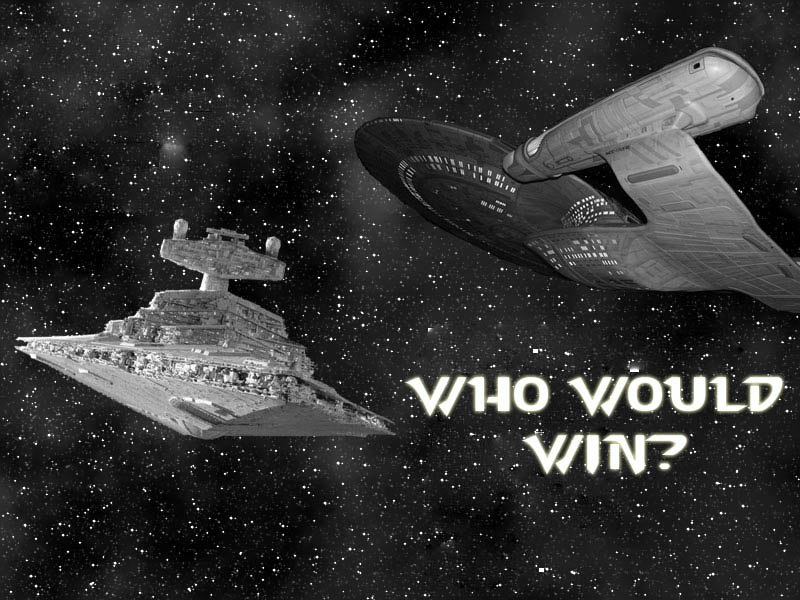
10. Star Trek vs. Star Wars.

A contentious battle rages between fans of Star Trek and Star Wars as to which universe could beat up the other universe. As a geek it should be obvious that they aren't easily comparable, but that doesn't stop them. Oddly, since the fan base overlaps to a wide degree, you'd think that most fans would be able to find some common ground and sit around and watch the shows that they love on an alternating basis.

Hardly. Just like sports fans, geeks have a massive set of numbers, statistics, off hand comments and other trivia with which they can wage month long vicious battles that set friend against friend. Their contests are merciless.

Unlike some of the later examples of flamewar subjects, Star Wars vs. Star Trek flamewars tend only to happen when there are deliberately provoked. Many Star Wars of Star Trek threads continue without issue and only deteriorate when deliberate comparisons are drawn with the opposing franchise.

Considering the viciousness, it's worth pointing out that the two intellectual properties were developed with wildly different intentions and themes. Star Wars is more closely related to an epic fantasy than the optimist futurism of Star Trek. Star Trek endeavors for a realistic future feel and offering commentary on real social situations and technology while Star Wars is meant to be entertaining and flashy and impressive.

That means that most Star Wars ships will win in a fight. As long as you ignore the Borg.

9. Circumcision.

If you've never been involved in a circumcision flamewar, consider yourself lucky. They are surprisingly heated ordeals in which cut men and "nice, all-American" girls argue for circumcision ("I just like the way that it looks" and "they're normal") against uncut men and "sluts" who argue against it ("It feels better" and "It's more fun"). It doesn't help matters that both sides also have well-intentioned authoritative supporters: nurses are often against the procedure and AIDS researchers are for it.

Many nurses apparently often argue that not only is it cruel and painful to the child but that it's a risky cosmetic procedure done without the informed consent of the patient. On the other hand studies in Africa have indicated that there is a reduction in the chance of HIV transmission for men that are having unprotected sex if they are circumcised.

There are second level arguments on both sides. Proponents will argue that it's a fairly safe and approved cosmetic procedure that normalizes the appearance of the penis. Those against it point out that condoms are many times more effective at preventing HIV transmission than circumcision.

Usually when circumcision threads show up they seem harmless at first. After all, compared to abortion most people wouldn't consider circumcision a big deal. However due to it's popularity in America, and the fact that men feel attached to what happens to their penises, a lot of people have developed strong feelings for or against the procedure. A few words about one person's uncut penis as opposed to what another person did to their kids and those strong feelings can erupt in a heated manner.

8. The War in Iraq (and Terrorism).

Although they have produced a lot of rhetoric and name calling, the war flamewars are surprisingly tame when it comes to a fundamental level. After all, most people seem to agree on the basics: winning, supporting the troops, and defeating the terrorists are good things while losing and getting attacked on American soil are bad. If you agree on so much, there's really only the minutia to fight over before the argument moves on to something else.

Basically, what these flamewars tend to do is drastically distort people's actual positions to produce controversy, or devolve into personal competency arguments involving politicians (which results in a Dem vs. Rep flamewar, see #2). This means that while the words thrown back and forth are heated, they don't seem to score as many hits as more vitriolic flamewars.

While the best war flamewars will be partisan, you can also get minor flamewars wherever someone suggests a specific strategy.

The major exceptions to the war flamewar as outlined above are those that erupt between those people that want to examine why the terrorists hate us, and those that think that ascribing human reasoning to terrorists is somehow material help to those terrorists. I've never understood why a minority of people believe that talking about the history of the Mideast is somehow problematic. These people can make war flamewars especially vitroilic but have been mostly shouted down recently, lowering the subject of the war one or two notches down this list.

7. Gay Marriage.

The general agreement among the largest number of people is that the government shouldn't be involved in marriage, just in granting civil unions. Since civil unions aren't "marriages" then religious people don't care if the government gives them to homosexuals and homosexuals and their allies don't feel like they're getting the short end of the stick.

The problem is that the government is deeply involved in "marriage." It exists in the tax code, in state constitutions, in inheritance law and all other sorts of crazy legal facets. It's really hard to change. Additionally, there's a minority on both sides that really want the word "marriage" to continue to be administered by the government because they think that the changes will suddenly render their relationships loveless. Or something.

Thus, the gay marriage flamewar is born. Even though there seems to be a fairly reasonable middle ground, the people on the fringe keep everyone else from getting close to some sort of agreement on the issue.

Often there's a religious undertone to gay marriage flamewars, which provides a little extra fuel for the fire, and allows for all sorts of "Leviticus 18:22" one liners to commonly appear. Sometimes someone will claim that if gay marriage is legalized their personal church will be forced to perform the services (although this idea is patently ridiculous).

Interestingly, although gay marriage can result in some very large flamewars, they typically only erupt around major announcements, like a judges ruling or a major statewide vote. There's a certain "gay marriage" critical mass required before the sparks really start to fly but once it's reached things heat up quickly.

6. Gun Control vs. Gun Ownership

I don't think there's another issue on this list, with the possible exception of the first place finisher, in which the opposing sides spend so much time ranting about things that their opponents are not saying. Each side constructs elaborate straw men that have nothing to do with their actual position on the issues that matter, and then foam at the mouth about them.

It doesn't help that the Second Amendment is out of date. Militias? Nobody today is in a militia, so what does that amendment even mean? But most gun control advocates are not advocating taking people's guns away from them (notice the key word "most") and most gun owners are in fact law abiding citizens that arm themselves for personal, family, and social protection.

Thus, you have the people that are pro-gun control and the people that are gun owners.

Never the twain shall meet in polite discourse.

You'd think that since this amendment was part of the original bill of rights, it would have become a quiet academic concern. Instead, a mention of gun control or a particularly violent killing (usually in Texas) can spawn a horrific flamewar about this subject.

5. Free vs. Regulated markets.

A laissez-faire system will result in untold wealth for everyone, says the free market enthusiast. Except that corruption, croynism and class stratification will occur, so economic systems have to be closely controlled, retorts the market regulator.

Although addicting, emotional, and interesting, this central battle of economics has never been resolved. There really has been no workable anarchist economic system feasible to give the Objectivists their try, and attempts at incredibly restrictive economic conditions have mostly failed.

A capitalistic mix seems to work well, but no two people seem to agree on exactly where the line should be drawn. The economic conservatives today suggest that the current economic problems are the result of over regulation of industry, and the economic liberals see it as the opposite. Since economics is more closely related to palmistry than a statistically rigorous science, no one knows who is correct.

It doesn't help that the issue is closely related to the existence of social programs. The libertarians find it unfair that they have to support those that have failed and the bleeding hearts find it unacceptable that we would allow people to starve or freeze due to market conditions.

Thus, the major divide in economics continues to provoke flamewars.

4. The Existence of God.

Considering that this question attacks the very fundamental nature of the reality in which people live, it isn't surprising to me that people feel so strongly about the subject that they're willing to lay out everything they can to either rally support or attack the other side.

Another sticky issue is that neither side can actually prove it's case, resulting in long frustration for both sides, who often end up lost in tiny bits of minutia or at a dead end when a believer says "Because I have faith" or an unbeliever says "Prove it."

Although there are specific instances in which the flamewar is based on a particular provocation (like a Richard Dawkins letter to the Times), this is a flamewar subject that doesn't necessarily have to be provoked. A casual mention of God, or an offhand comment by an atheist can sometimes create a flamewar where there was only a peripheral connection before.

Another problem with this kind of flamewar is that it only very rarely strays from certain fixed tropes or one liners. Keep a watch out for the "Problem of Evil," Ockham's Razor, various incarnations of Pascal's Wager, and the Flying Spaghetti Monster.

3. Abortion.

Considering that it is based on a small range of medical procedures, abortion is one of the most contentious of all internet topics. It has spawned entire real world organizations with members numbering in the millions beyond the numerous websites and message boards that some of the previous topics have to back them up.

Basically, the arguments boil down to a question of whether you support murder or slavery, and neither side is willing to accept "no answer" as acceptable.

One of the most interesting things about abortion flamewars is that the implications of each side have real world application. In a world that has banned abortion, you would be either locking women up for the protection of their unborn children or punishing them for getting rid of unborn children. In the current system, hundreds of thousands of what could considered to be lives are being lost. This is an important ethical question that is worth major consideration.

This is basically the "single issue voter" issue, and every election thousands if not millions of dollars are spent over the slightest steps back and forth. There are even linguistic breaks that are used to differentiate the sides and cast each other in a negative light.

Also, even though you'd think that both sides would want to keep the number of abortions down, that isn't always the case. Thus, the abortion question is sometimes related to the question of abstinence and abstinence plus sex ed, which barely missed the cut-off for this list.

Personally, considering the consequences of a person's stance on the position, I do understand why this is one of the big questions facing Americans today.

2. Democrats vs. Republicans.

If there's anything that the two party system has taught me, it is that populations are easily polarized. One of the clearest examples of this is in the virulent hatred of the opposing political parties here in the U.S.

People can't just disagree with each other, they have to stand up to the evil which is the opposing political party.

There are a few exceptions to the rule, a few bipartisan elected officials that do their job well and are widely liked on "both sides of the aisle." However, once on the national stage, they pretty much no longer exist. No matter what they do, they'll be torn down by the opposing side, who doesn't want the other guys to get a political advantage over them.

One of the biggest problems with these flamewars is that there can be no rational discussion. The sides talk past each other and since people personally identify with their parties they are personally hurt when any criticism surfaces.

Then there is the further problem that there are actually (at least) two axises of political thought in the United States, social and economic. Thus, half the time when you are talking to someone of one political party, they will only disagree with you on one axis and not the other. Socially liberal Republicans are tarred with the "right wing anti-choice anti-gay marriage" label and fiscally conservative Democrats are called "left wing 'tax and spend.'" As you can imagine, this can creates bad feelings on both sides, even though by supporting one party or the other you are implicitly endorsing both their economic and social policies.

Political flamewars recently have also seen the rise of the "concern" troll, someone that pretends to be affiliated with a party only to offer backhanded compliments and misinformation. Unlike a normal troll, concern trolls are harder to detect and can gather a substantial backlash on the way to a flamewar. While usually these types of trolls would be used to mock the opposing side, in the political arena they can actually rise to national and political prominence.

It also helps that many people strongly identified with parties are also incredibly divisive. George W. Bush, Bill Clinton, Dick Cheney, Nancy Pelosi, Karl Rove, Ted Kennedy, and Rick Santorum are all easy ways to lead into a political flamewar. Sometimes an individual figure can kick off a Dem vs. Rep flamewar by themselves, such as the way that Sarah Palin recently has been able to do or George W. Bush managed for years by himself.

Sometimes the best Democrat vs. Republican flamewars merge with one of the previous flamewar subjects to create a super flamewar (although usually not "Star Trek vs. Star Wars"). After all, if you've got the above mentioned controversial figures to point to during a flamewar about economics, you can anger more people at once. And find a way to bring in abortion. And dis circumcision.

One of the only problems with political flamewars is that they're one of the few kinds of debates that can get over saturated and lose their focus. So much political stupidity can happen in a single day that people won't know which thread to post in. Sometimes instead of one daily political flamewar there will be a slew of smaller ones that don't get nearly as vicious and tend to peter out quickly.

1. Evolution and Creation.

Absolutely the top of the pile for utter raving insanity, the debate between evilutionists and creatards is the current major battlefield between science and religion and the only thing capable of overthrowing political parties as the best flamewar subject. Nothing seems to bother the deeply religious more than an insinuation that we might not be the result of God's plan and nothing seems to bother the scientific community more than the insinuation that their years of study and careful examination are wrong because an old book says so.

Thus, the best flamewars are born.

Considering that unlike presidential or party politics the vocal supporters of creationism are a minority in the U.S., it would be easy to assume that this flamewar doesn't get much play, but nothing seems to provoke a flamewar faster. After all, both sides believe that they have the "truth" and there doesn't seem to be a quicker way into the heated flames of online battle than that.

Interestingly, unlike the Existence of God flamewars mentioned above, the existence of actual evidence does nothing to reduce anger and force with which these arguments are put forth. In fact, I would argue that it increases it. While the question of the existence of God is something of a stalemate, the debate between creationism and evolution has become a question of "Who do you trust?"
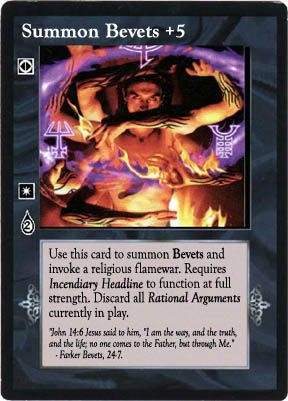
Specifically, evolution and creation flamewars are the nexus of debate between fundamentalist Christianity and atheism, even more so than the Existence of God. While the middle of the road might argue about the existence of God, the extremists are the ones that argue creation and evolution. Added to that are the examples of Richard Dawkins and PZ Myers, biologists and atheists that characterize the evolution supporters that have become famous in their own right for their outspoken opinions on this particular topic. As a farker, there are a couple of notable creationists as well. No, I'm not talking about Michael Behe or Kent Hovind but Bevets, the oft summoned indicator of a true Fark evolution/creation flamewar.
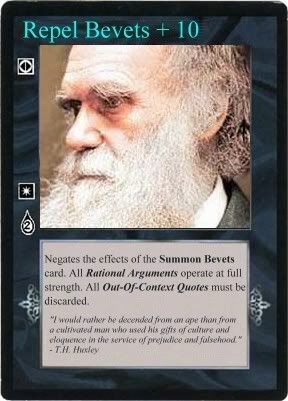
Probably the most legendary troll on Fark, it's hard to think of another internet user that is as defined by a particular subject more than Bevets and his creationism. Possibly Scalzi and bacon, but I doubt it. Almost without a subject break in years, Bevets is the tireless apologist for creation, even going so far as to host his own website with common arguments so that he can throw up links to longer rants without needing to retype them. Granted, there are sites like TalkOrigins that refute him, but Bevets does his long and exhaustive work on his own, thus earning him recognizable card game adaptations on Fark.

These debates also led to one of my favorite eponymous law: Poe's Law, which basically states that it is nearly impossible to determine the difference between a parody and a true believer. Although born in the evolution/creation debates, I've found Poe's law useful in other arenas (particularly politics).

Creation/evolution flamewars can be started over the smallest provocation. A mention of a 40 million year old fossil will sometimes provoke one, as can articles on geology, epidemiology, genetics, Mideast history or even meteorology (see vapor canopies). Then there are the subjects that can suddenly morph into creation vs. evolution debates. For example, someone arguing about the existence of god/God might use evolution or creation of proof of one of the positions. The same with the inerrancy of the bible, or carbon dating, or even a discussion of different scientific theories. If you accidentally mention that the cute kitten in the photoshop contest evolved you might have a flamewar on your hands.

Of course this is in addition to the multiple creation museum articles, advances in evolutionary biology and school board "teach the controversy" or evolution banning threads that seem to appear on a weekly basis.

Considering the nearly one hundred and fifty years that these debates have been raging, not to mention the entire religions and governments that have weighed in, this is also a historically weighty flamewar. Mentions of Darwin (both as evidence for the science supporters and as a "Darwinist" insult from the religion supporters) and shepherds that have been dead for 2000 years (mostly as an insult to Biblical literalists) abound.

Finally, I'll end on a high note and point out that it's fairly easy to Godwin a creation/evolution flamewar. After all, the Nazis were evolutionists, no?


The runner up subjects were sex education in schools, various sports team rivalries, "activist judges" (i.e. rulings that we don't like), and breastfeeding. Yup. Breastfeeding. You'd be surprised.

The Honorable Mention is:

Apple vs. (Microsoft) PC.

Starting the list off is one of the most pointless debates that I can think of, yet one that manages to devolve into a name calling match most times it appears. Any time there's a comparison of some kind between Mac computers and PCs, there's always some people that feel the need to belittle people that don't own the same sort of computer that they use.

This is partly due to the Apple marketing campaign which goes to such great lengths to establish the duality of the products and promote their brand as the hip and cool alternative. This does overlook the fact that they are a niche family of products, and even if they could compete with the wider PC market, doing so would probably drag them down to encompass some of the same problems that PCs embody.

Additionally, then there's the Microsoft angle, in which people get to hate on Microsoft. Unfortunately, in this monopoly of hatred, there isn't another company that can take on a serious mantle of opposition to the mighty "M$" more than Apple, and so Apple receives the bulk of the attention. The real rivals to most Microsoft products are unknown to the bulk of Americans, and thus invisible during the flamewars between Apple fanboys and Microsoft drones.

Thanks to the long term "We're better than they are" campaign run by Apple, these flamewars have been surprisingly persistent.

Labels: , , , ,