Worlds & Time

Monday, May 30, 2016

Praying for you & Free Will

I saw someone pull the old "I'll pray for you" to an gynecologist the other day on Twitter, and one of the videos I was watching on YouTube (I can't recall which one, sorry) had been talking about God's position on free will.

Generally, most of the Christians that I've talked with have insisted that God doesn't interfere with human free will.  There are a couple of reasons why they have to argue that, both Biblical and related to the problem of evil.  After all, if all evil in the world is caused by the fall of man, and Christians have salvation in Christ, one might expect God to intervene to protect Christians or perhaps the innocent.

Spoiler alert, that doesn't happen.

If everything is the fault of free will, including death and disease and etc., then that allows Christians to side step the issue of what God could be doing while still blaming humans. Humans brought any pain and suffering on themselves and others, and any interference in that would somehow meddle with free will, somehow.

Also, just to point out, the belief that god doesn't interfere in free will is explicitly contradicted in the Bible.  God hardens Pharaoh's heart multiple times, preventing him from making reasonable choices in the face of the plagues that Moses is bringing down on his people.  And just to note that these choices are directly linked to the possibility of Pharaoh's salvation.  If he believed the miracles that he was witnessing first hand, he might have decided to worship the god of the Bible.

I suppose I should also point out that faith instead of knowledge being required for salvation is also murky.  After all, if early Christians witnessed the miracles of Jesus of Nazareth, they didn't need to have faith in him, as Christians today will define the concept. 

So, ignoring Pharaoh, if God really doesn't interfere in free will, what exactly are people asking for when they say "I'll pray for you"?  the vast majority of those people are praying to a God that they themselves don't believe will change a human's mind.  Not because he can't but because he actively refuses to do so.  So . . . they're praying for God to do something that they know he won't?  Actively praying against the explicit will of God?

There's an atheist meme, "Prayer: How to do nothing and pretend that you're doing something."  However, assuming that the people aren't pretending but actively hoping for a change, saying "I'll pray for you" is even worse, because as honestly as you might hope for a change you're also sure that it's not going to happen.

It's quite literally praying for nothing.

Labels: ,

Friday, May 13, 2016

The Lack of Objective Morality in Religious Morality

To lay out the basis of this post, I was debating with a polite conservative Catholic on Twitter a few months ago, and he asked me about where my morality comes from if it doesn't come from God.

So, I tried to explain, briefly (as befits Twitter), that my moral system is based on a couple of basic principles.  At the time I feel like I only really worked through the first, but I've added two additional principles here to try to further explain my thought process.

  1. It is possible to differentiate between moral and immoral acts based on a framework of empathy and relative harm.  Eventually this devolved into "feelings are meaningful" but obviously there's substantially more to it than that.  A large part of why this is a basis for morality can be described as the "Golden Rule."  Treating people the way you would want to be treated is good, treating them as you wouldn't want to be treated is bad.
  2. Morals are situational.  That is, the more that is known about a situation, the more well understood the morality of the situation.  Saying that "hitting someone" is moral or immoral is difficult if not impossible based on the vague nature of the presented situation.  Additional information can easily turn an immoral act into a moral act.  However, the morality of a situation can be judged from the best, if imperfect, understanding of any situation.  
  3. Morality is not relative.  If two situations are precisely the same, then the morality of both those situations is the same.  Any differences between two situations, no matter how slight, might change the morality of those situations.

Additionally, because I was debating a Christian on this, at some point I stipulated two additional things:

  • The world exists.
  • People exist.
I should have additionally stipulated that there are moral, immoral, and amoral acts.  That sometimes choices have no real moral content.  I didn't think about that at the time, but I'll try to recall that for next time.  As it was, I'm glad I stipulated to at least the two things above because they headed off the worst of the "How do you know?" and "What if you're wrong?" questions.

Just a note, Matt Dillahunty's talk on secular morality, "The Superiority of Secular Morality" helped me understand and phrase my own point of view of this subject.  Thanks to him for his excellent discussion there, and on episodes of The Atheist Experience.

So, I was trying to understand the conservative Catholic's framework for understanding morality so I asked a series of questions, which all really boiled down to "where does your morality come from?"  I'm paraphrasing here, obviously, but he stated that moral and immoral acts should be clear to people because of his god's revelation, especially to Catholics.  When I asked how some Catholics could disagree about morality, his reply was that one of the Catholics would be wrong, and that wrongness would derive from the failure to understand or submit to God's will.

That's where I started getting really interested, because to me it seems pretty clear that this is where we split on my principle number 1.  While I think that morality is based on empathy and relative harm, he thinks that it's based on the will of God.  In that sense, I think he would accept my second principle, but only where better understanding of the situation can be clarified by the Bible or his god's will.

I kind of followed that through to my third principle and realized that while there was a difference of opinion in principle number 1, the third principle fell apart completely.  We were both talking about objective morality and we were talking about two completely, completely different things.  I wanted to try to focus on that, but first I wanted to talk more to establish a larger basis of common terms and ideas with which to discuss it.

I don't generally use the term "absolute morality" but when I followed that thread down, my understanding was that "absolute morality" was the morality of his god, and that while it existed to him, it could not be perfectly understood by imperfect beings.  So it was a real existent thing, but it also wasn't something that we humans couldn't completely grasp.

To underline that he said "Morality isn't determined by men but by God."

We spent most of the rest of the conversation talking about why people's feelings matter to morality, and how morality can be based on harm, societal impact, feelings, and all of the other things upon which I base my premises.  He views feelings as evidence of moral law, which I obviously don't.  I pretty much view things from the opposite direction, moral law is evidence of feelings.  Human morality is what we build up on top of the basic observable effects of our actions on other people (which, if you'll recall, I had to stipulate existed). People are hurt by cruelty and abuse, and they suffer and society suffers as a result.  Being nice and moral lead to better outcomes, both for individuals and society.

I do need to clarify that all of this is based on the idea that people are physical beings, and that feelings and harm are physical states.  Society is also a construct made up of many people, all of whom are physical beings.  Since I'm observing physical people though, I can make objective statements because the statements I'm making literally relate to objective reality.  

I continued to consider this after the conversation had finished, and I came to a few additional realizations.

First, given two situations that are morally equivalent but not exactly the same situation.  A simple moral situation to use could be two men, acquaintances but not friends or relations, one of whom is jealous and kills the other to rob him.  So we have four people, two murderers and two victims.

To me, given similar moral circumstances (neither of the murderers was acting in self defense or for the defense of another, the motivation was robbery in both cases, and the murderer wasn't coerced or forced in any way) I can say that both of these situations are bad because the actions of the murderers are both immoral.  The murderer is clearly wrong to do what he did.

I can say, given the situations, these killings are objectively bad.  Does it result in good outcome for both parties?  No, half of them end up dead.  The killers' financial windfall doesn't mitigate the loss of life by the victims.  Murder 1 is objectively bad, and Murder 2 is objectively bad.

There is a major missing factor for some other conservative Catholic to judge the situations though, which is the will of their god.  Let's assume that Murder 1 occurs without countenance from God.  Then my hypothetical Catholic friend clearly says that the murder is objectively wrong and bad.  Assume though that Murder 2 occurs but is condoned by God (for any reason, known or unknown).  Well, then my hypothetical friend would have to say that the murder is objectively good.

Aside from the opinion of God, what has changed in the situation?  Well, nothing.  Two people have still murdered two other people.  The direct circumstances of the situation haven't changed, and to me the opinion of God doesn't change anything, both are still bad.  To me, the actual situation matters, not what the opinion of a third party is.

To my hypothetical philosophical sparring partner, the situation doesn't actually matter at all.  What matter is the opinion of that third party.  So "robbing and killing" someone isn't actually an objectively immoral act, because the determination rests on the subjective opinion of a third party.

I think it's obvious that the immediate response to this would be "God wouldn't condone killing."  Except, clearly he has.  He condoned and even ordered significant amounts of killing in the Bible.  Some Christians argue that this was a moral thing because killing is not against the command of God, but murder is.  To some extent I agree about the difference between "killing" and "murder," but my agreement is all situational: was it in self defense or in the defense of another?  For the hypothetical Catholic though, again, the actual situation doesn't matter, what matters is the approval of God.

And, of course, I'm assuming the manifestation of God to the Catholic to make his will known, which I know is unreasonable.  As my real Twitter acquaintance made clear, it's impossible to perfectly understand the mind of God.   That just makes me more confused about why they think that their morality is "objective" though, because the opinions of God are unknowable.  Who can say that God wouldn't prefer stoning of atheists, idolators, and blasphemers today or that our society has violated the will of God to forbid Biblical slavery?

There might be an assumption, especially for non-prophets, that certain acts are acceptable or forbidden by God according to the dictates of the Bible, but those are just assumptions.  It would be impossible to discern the exact feelings of their deity on each specific case. 

Thus, it strikes me as completely ridiculous that Christians claim that their morality is objective.  It certainly has nothing to do with the objective reality of the situation, or even really of their own laws or opinions.  It's clearly a subjective morality where the "subject" is their god.

Certainly, the more accurate assessment would have to describe secular morality as more "objective" than the muddy and subjective morality that requires a constant stream of opinion from God.  After all, it's much easier to say "robbery and killing" or "kill their men and capture their women" are immoral in the secular system than in the religious one.

Labels: , , ,

Sunday, February 22, 2015

Quick Disproofs of God: Argument from Entropy

1. Entropy affects everything
2. If God exists, he must be perfect
3. If God was perfect at any time, then entropy means that he is not perfect after that point.

Therefore God is not perfect and thus cannot exist.

I think that the obvious point of argument on this one is the first premise, that entropy affects everything.  However, there is really no evidence that there is anything that is not affected by entropy.  You'd have to basically prove that there are things that are not subject to entropy.

Also, just an observation, there's no evidence that entropy is limited to just the universe.  It may be an absolute inviolable law.  So even if God was "outside of time and space" there isn't any evidence that he isn't subject to entropy.

Labels: , ,

Sunday, February 15, 2015

Quick Disproofs of God: Argument from Morality

1. If God exists, then there is objective morality.
2. If objective morality exists, then it must be apparent to all people, or at least all followers of God.
3. If there is any change in morality over time in the societies that base their morality on God and the Bible, then there is no objective morality.
4. Morality has changed over the last two thousand years, even among the followers of God.

Therefore, there is no objective morality, and there cannot be any being that has objective morality.

Some may suggest that societal morality is a bad baseline to judge the existence of objective morality, in which case society can actually be swapped out for any specific person that claims to have objective morality and someone else they agree to have objective morality (such as Jesus Christ).  As long as the morality of that person is slightly different than the morality of Jesus Christ, there is no objective morality.

Labels: , ,

Sunday, February 08, 2015

Quick Disproofs of God: Ontological Argument

1. If God exists, he must be perfect.
2. If he is perfect, he must be objectively perfect.
3. Objectively perfect things do not exist.

Therefore, God does not exist.

Obviously the premise that most theists will have an issue with is the third one, but it appears to be quite true: There are no things that everyone could agree would be perfect.  Zero.  The more "perfect" something is judged to be, actually, the less chance it has of actually existing.  Therefore, it would be logically impossible for an objectively perfect being to exist.

Labels: , ,

Friday, February 06, 2015

A thought that is entirely internal to the framework of Christian logic

I don't think that Andrew Wilson really understand what "sin" is, at least in the context of this clip. He badgers Ron to admit that homosexual sex is a sin, which Ron doesn't want to say because Ron knows that admission is damaging to his relationships with gay people (absolutely true, because gay people have been so long singled out as special sinners). However, Andrew doesn't acknowledge that heterosexual sex is very often a sin to God too and that men can commit the same sin just by looking with lust at other women (Matthew 5:21-30). All men, heterosexual or homosexual are sinners in the view of God, and I suspect that it would not be too great a leap to say that all men are sexual sinners in the view of God.

So he's asking Ron if homosexuality is a special sin, one that must stop when accepting Jesus Christ to the extent that many preachers lie and say that God will remove the temptation. Obviously that's wrong, because salvation doesn't work that way. Accepting Jesus doesn't stop men from lusting or coveting or anger, and those states of mind are, in the words of Paul, just as bad as the sins themselves. Christians have to accept that in accepting Christ, they will find salvation after they die, and in their efforts to live better lives on Earth, He will help them live better but not perfect lives.

My question is then, what life better exemplifies that of a Christian with homosexual attraction? Drugs, casual sex, and suffering the persecution of the church, or the embrace of the church and blessing of a stable sexual partnership in a homosexual marriage?

My final thought on this conversation is that Jesus said: "Therefore what God has joined together, let no one separate." The context was divorce, a sin, but it seems to me that those who actually know gay people know that they may habe been joined to their loving same sex partners by God. Let no one demand the separation of two gay men or two gay women as a prerequisite to joining the fellowship, as they have also been joined together by God.

Labels: , ,

Sunday, February 01, 2015

Quick Disproofs of God: Cosmological Argument

1. The universe exists
2. The universe has a beginning
3. Time also began when the universe began
4. The idea of being "created" requires linear time to have meaning
5. There was no concept of linear time "before" the big bang (indeed, even the concept of "before" the big bang is meaningless)

Therefore, the concept of "creating" the universe is meaningless.  Even if something was required to "create" then universe, that concept is negated by the fact that time began at the beginning of the universe.

This argument also covers the similar argument that God could "cause" the universe.  The idea of causation requires temporal dependence ("this action causes that result" requires the action to occur before the result) and therefore it is meaningless to say that anything "caused" the universe.

The subsequent premises are something to the effect of:

6. If the Bible is true, then God must exist (and conversely, if it is false, then the Bible's particular idea of God must not exist)
7. The Bible says that God created the universe

Since the idea of creating the universe is meaningless, then the Bible is wrong and God can't exist in that form.

Labels: , ,

Friday, October 11, 2013

A Brilliant Thought on Certainty

If a person says that he met God with total certainty and is not touched by a margin of uncertainty, then this is not good. For me, this is an important key. If one has the answers to all the questions -that is the proof that God is not with him. It means that he is a false prophet using religion for himself.
The great leaders of the people of God, like Moses, have always left room for doubt. 

— Pope Francis

Labels:

Thursday, February 25, 2010

Boiling Water

I was reading through some old comments on another blog today and I came across a point that I'd made when arguing about the origin of suffering and God's response to it. It's a small fragment of the Problem of Evil.

God could have prevented thousands of years of people's suffering without infringing on any person's free will if he had simply said that boiling water makes it sterile. He didn't have to explain why, all he had to do was say somewhere in the Bible that wounds should be cleaned with water that had been boiled and then allowed to cool. This would have allowed thousands if not millions of people to survive sepsis or infection. It would have saved hundreds of thousands of lives but wouldn't have prevented humans from stabbing, killing, or otherwise being evil to each other.

Further, boiled water is safe to drink (safer, that is). Why didn't God point that out somewhere? If he really loved us, shouldn't he have included in his many laws and instructions the best way to make water safe for everyone to use?

At the time I made that point, I ended with: "I’ll leave you to direct me to those passages of the Bible but I’d be waiting forever. They’re not there." That is about all there is to it.

Labels:

Thursday, August 06, 2009

Understanding Anti-Gay Marriage Arguments

So, as far as I understand it, the three main arguments against gay marriage are:
  1. It's not traditional. (Also seen as: Marriage is the fundamental unit of society)
  2. I don't like the thought of gay marriage. (Also seen as: Gay marriage is icky or I don't want my kids to see it)
  3. Gay marriage is against my religious beliefs.
  4. There isn't any reason that gays should want marriage anyway.
I'm not much for tradition, so I feel that 1. is a hollow argument. Americans try not to legislate our own personal prejudices so 2. is certainly not a valid argument.

3. is more complex. I feel that the best argument against it is pointing out that by legislating a person's religious beliefs you are egregiously violating the first amendment. You see, there are people with other religious beliefs out there that do favor gay marriage. The Unitarian Universalists, the Metropolitan Community Church, the United Church of Christ and many reform Jewish temples all support gay marriage. Those churches represent millions of Americans, all of whom are having their freedom of speech trampled by larger denominations that want to be able to have their own sacraments legally recognized but prevent the smaller churches from doing the same.

The reason for this post is number 4. though. You see, I've noticed that this response is usually related to a single argument against gay marriage. When you ask people why straight people should want legally recognized marriage but gay people shouldn't the answer is usually: for the children.

According to a lot of the anti-gay marriage Christians that I've had the pleasure of being disgusted by over the years, since gay people are incapable of creating a baby, they shouldn't have the legal status that straights have to take care of the child.

Personally, I thought this was ridiculous, and I've pointed this out numerous times. Gay people may not be able to have sex with each other and procreate but the can and do take care of babies through adoption or surrogacy or sometimes even heterosexual sex (we may refer to those people as "bisexual"). Recently, I finally got a response that floored me.

Gay people shouldn't be able to raise children.

Okay, that's a fairly serious negation of my counter argument. If gay (and bisexual) people were not allowed to raise children then that does in fact mean that there would be substantial difference in the necessity for legal protections from gay families.

It would also require tens of thousands of children to be forcibly removed from their parents (sometimes blood parents and often the only parents that the child has known).

Don't forget that this is a Christian that I was talking too. A Christian that apparently thinks so little of gay people that he finds nothing wrong with denying them the ability to raise their children.

You can see him say that in the comments to this post on his blog.

He'll think that I'm being hyperbolic. But I think that when someone gets the point that he is at: denying the ability of gay people to be decent, loving parents, then perhaps a little bit of hyperbolic language is justified.

So, that's his trump argument. Gay people don't need legal protections to protect their children because they shouldn't be allowed to have children. Not only should we not be considered able to make the choice to marry, but we also not be considered good enough to raise children.

If you were curious, that's prejudice. That's what gay people want to get rid of in this world.

Labels: ,

Tuesday, June 30, 2009

Heads by Greg Bear

I just finished the Novella "Heads" by Greg Bear.

It was pretty good, the characterization could have been better and the end was sort of predictable but it had me worrying there for a while.

You see, it's been a while since I picked it up from the bookstore. Even then all I knew about it was that it was a Hugo winner. If I knew anything more than that about it, I'd forgotten it so it was a blank slate to me.

As I was headed into the last few pages (*cough*) I couldn't tell if it was going to be a ringing endorsement of Scientology or a scathing denouncement.

It is definitely about Scientology though. It's so thinly veiled that it's beyond gauzy and into the realm of body paint. Thierry is Hubbard.

I don't know much about Greg Bear. He could have been a convert, for all I know. He could have had some other reason to want to ingratiate himself with the Church or want to support them.

But he didn't. Instead, he shows in a novella why Hubbard should be disregarded. It might be a fictional work, but so's Dianetics.

Labels: , ,

Thursday, March 05, 2009

Understanding Christians and Everyone Else Too

I used to deal with lots and lots of Christians online. I was a moderator for one of the largest atheist message boards and dealt with the largest group of Christians there. I'm also a member of the largest "Christian" message board. Depending on your definition of Christian, obviously.

Renaissance Guy: We do not believe that Christians are good and other people are bad.

Great. That's definitely one of the biggest issues that I've had with Christians over the years. People like Angel4Truth, Emmy, angellica, or ShieldOfFaith absolutely believe that Christians are the only good people. It's really hard to evangelize when you've already set yourself up as perfect and morally superior.

I guess the question that I have for you is: When do you believe that you are saved? (Slactivist's answer is "About two thousand years ago" but his answer avoids a serious theological question that is absolutely necessary to answer before discussion about Christianity between believers and non-believers becomes possible.) When you become a Christian, are you wiped of any desire to sin? Do you stop sinning? Because if you believe this to be the case, the conversation ends. It's obvious that Christians do sin, that they are sinners. They are not more perfect than we are.

There is also the problem of pride, however. It isn't just the attitude that "we know what sin is" but "we know what's best for you." The former is not necessarily harmful during communication but the later is. When you are required, as you have previously said that you are, to tell people they are sinners you are absolutely a member of the later.

As an atheist, I know what's best for you. It's to give up Christianity and learn the Truth. Capital T, Truth.

Notice how your eyes glazed over during the first sentence in the previous paragraph? How you suddenly find me pushy and stupid as soon as I implied that I know what's best for you? And using Truth with a captial T? Ludicrous. How do I know? I'm just an atheist . . .

Right. That's also exactly how I feel when you tell me your Good News with the knowledge that I need to hear it.

The problem is that I have heard it. I know the Bible. Not as well as you, but better than a lot of Christians and I'm definitely familiar with the basic theological arguments and the story contained within the Gospel.

Let's bring this back on track. I said there was a problem of pride and it's the same problem of pride that Chick tracts have: If you assume that your audience isn't familiar with Christianity, you've already lost most of them by failing to understand where they're starting from.

You might be shocked at how many Christians came to the atheist message board where I moderated and thought that posting the story of Jesus would convert people. Or that letting us know that we're going to Hell would suddenly make us realize that we need Jesus in our lives.

I've previously mentioned that there are people that have seriously made me reconsider my atheism. Not a single one of them ever got me to that point by starting by telling me that I am going to hell. Or that Jesus died for my sins.

Rather, they listened. They realized that I am human and have human wants and needs. They listened to me and when I talked about my life they empathized. When I was lonely they were there, when I was sad they were sad, when I was happy they were happy.

They talked about their beliefs too. Never requiring them, never asserting primacy, but offering them up the same way that I would try to talk about atheism: this is what I believe and this is why I believe it.

I think that my point in all of this is that to understand non-Christians, Christians have to understand that to a certain extent we do understand them already. The difference isn't that great. The gulf between us is not vast. In most cases it's only a thin holy (or unholy) line.

I want to go off on a bit of a tangent now.

This is related to the treatment of gay people by "Bible-believing, orthodox Christians."

If you really do accept that all Christians are sinners, then accept that all gay people are sinners as well. They're just not lying about that particular sin. If Christians aren't led away from temptation when they become Christians (and they aren't) then it won't change homosexuals to become Christians. They'll just be gay Christians now, and they'll still have the same problems, inclinations, and sex drives as they did before. Only now they'll be saved in Christ.

It's fairly obvious to me that if becoming a Christian doesn't grant super powers, then one of the sins that homosexuals are going to have to have forgiven is the fact that they're going to be homosexuals. They can try to be the best people in the world and some gay Christians are going to choose a life of celibacy (I'll point them out, if you email me) but there are always going to be gay people for whom celibacy is not an option, just as there are Christians who can't live with celibacy.

So, they've got two options: monogamy or promiscuity. It makes me wonder when these Bible-believing, orthodox Christians are so weirded out by the fact that some people sin in this way that they will actively oppose these people from trying to form stable unions. If you're going to try to prevent sinners from getting married, don't you think that there are a lot of heterosexuals that they should be worried about first?

But they're not. They blithely vote against gay marriage, pat themselves on the back, and then go on to say that they can't support sin when in fact they just did. Support of gay marriage? It's a sin. But opposition to gay marriage also supports sin: more sins.

And to those that want to claim that marriage is a Christian institution that shouldn't be changed? The Jews are over there. Go talk to them about that.

Labels: , ,

Thursday, February 12, 2009

Darwinism

Today would have been Darwin's 200th birthday. You know, if he'd lived for two centuries. For the occasion RG made an appeal to popularity (nizkor) and asks "Or is [Creationism] just so pervasive?"

Considering the millions of dollars that believers in Creationism have to build museums, I would have to respond "Yes it is."

They still don't have anything to back it up, but they're on a mission from their god. Religion rarely lets facts get in the way.

Labels:

Friday, January 16, 2009

Love the Sinner, Hate the Sin

"Love the sinner, hate the sin" is something that I used to hear all the time when I spent a lot of time on sites like CF or IIDB. After all, there needs to be some way to dismiss Jesus' exhortation to "Love Thy Neighbor."

After all, "judging" people is bad in most Christian traditions. It usurps God's place. However, if what you judge is the intangible sin, then that's just fine. Completely acceptable. Informative even!

Recently, through a link over on Jesurgislac's blog, I came across a link to Renaissance Guy's post To judge or Not to Judge, where Renaissance Guy sort of backhands his way into that argument, arguing that Jesus shows what a great guy he is by telling the prostitute how she's a sinner and damned to hell. Or something to that effect. He thinks that being gay is a sin and he thinks that Christians should say so and speak out about it.

The point is, it got me thinking about that specific idea again; that you can love the sinner while hating the sin.

Then I just found a clip of a 20/20 investigation about same sex couples involved in public displays of affection. The police are called on a male gay couple making out in public in AL, but you don't have to watch the whole thing. The part that I'm concerned about starts at 8:38 and lasts about 10 seconds.

See it here:


20/20 official site

The voice over and the next line that I'm referring to are: "But while some like what they're witnessing, a silent minority can't hide their disapproval. Their faces say it all. 'To me, it's not that appropriate.'"

So, what is a gay person going to feel when they see that? I guarantee that it isn't going to be loved. As a sinner or anything else. All they'll feel is judged, even if the person says nothing at all.

Love the sinner, hate the sin may sound good to various denominations of Christians, but it's not the way that reality works. If you try it, hate of the sin is going to spill over onto the person no matter what.

Labels: ,

Sunday, January 11, 2009

The Anti Narnia

A quick short story inspired by Hal Duncan's much more interesting Thoughts on Narnia over at his blog. Yeah, I know he writes long posts, but check them out some time. They're worth it.

It was the quiet and pensive Lori that discovered the door and it was only the dramatic change from her usual shyness that convinced her brothers and sister to go through it into the magic little world that she had found.

Edward struck out on his own almost immediately. He read adventure books and thought of himself as an explorer that didn’t need his siblings to get in the way. So he alone discovered the ruins of the great castle in this frozen world. Most of it had fallen in on itself but there were parts that were still covered, sheltering their contents from the omnipresent white snow that covered the ground.

In the otherwise empty great hall he found the gold coin.

It was about as big as a penny and shiny enough to look newly minted, although the image on it was still hard to discern. He’d always dreamed of finding an old pirate’s treasure and the gold coin represented all this. Wait till the others saw it, he thought.

So he tromped back to the door where Pete, Sarah and Lori all were waiting for him with a giant talking rodent of some sort.

“We’re going to go,” said Pete. “There’s apparently a crazy tiger around here killing people.”

“And Mr. Bumbles here says that we can’t try to take anything back,” piped in Lori. “He says that it’s wrong to go mixing up universes.”

“You haven’t picked something up, have you?” asked Sarah.

In his head, Ed weighed having his own treasure stash with which he could lord it over his siblings for several weeks back home against the wrongness of mixing up universes and came to a snap decision. “Nope. Nothing at all.”

With a roar, a giant red-orange tiger jumped into the snowy clearing in front of the door. It must have been twelve feet from the tip of the nose to the tip of it’s tail, and it looked like it could rip any of them to shreds in an instant with it’s three inch long bloody claws. All the children flinched back, not knowing that they should be running, but Mr. Bumbles scurried away so quickly it was like someone had edited him out of a film.

The tiger didn’t attack though. It turned to Ed and said aloud “Naughty boy.”

Before it could get out another word a huge white swan descended from the sky. All around it glowed a fierce golden light, like the aura from old paintings around the holy family done in gold leaf. “No fear children!” it called in a voice like rolling thunder. “I’ll protect you! Whatever the Tiger corrupts, I, the Swan, am here to defend”

Sarah rounded on Ed. “You did pick something up, didn’t you?”

He squirmed but held out his hand and opened it, revealing the coin. Sarah rolled her eyes, and Lori sighed pitifully. Pete just looked jealous.

Ed turned to the Swan. “So, uh, sorry about that. Look, here’s the coin.” He put in on the ground and scooted it toward the bird when it didn’t move to accept the token.

The Tiger laughed, and the branches shook snow off all around the clearing. “You have done more than steal, you’ve lied to your kin. A betrayal if I’ve ever heard one. You know what the punishment for that is?”

Ed shook his head.

“We’re going to pour boiling lead in your eyes and cut out your tongue. Then, I’m going to bite off your fingers and toes one by one before opening your stomach and knowing out your intestines.” The Tiger scrunched up its face as though it was thinking. “There’s something about rape in there too. I’ve got it written down somewhere. I’ll have to look it up. It’s part of the Great Laws of this land.”

All the children looked positively sick.

“I’m sorry,” Ed said, his eyes filling with tears. The Tiger was now licking its lips and inching closer to him, sniffing the air.

“He’s eleven,” Pete said. “I mean he’s just a kid. That’s ridiculous. This is a fairy tale, right? Surely there must be some quest he can go to make up for this.”

The Swan shook his head. “Nope. No quests. The boiling lead and the eating and the rape sounds about right.”

“What?” demanded Sarah. “Sounds about right? Are you kidding? I thought you said you were here to protect us.”

The Tiger reached out with a huge claw and poked Edmund in his shoulder. A stain of red started to spread slowly under his shirt and the Tiger licked at the blood like it was barbeque sauce.

“I am here to protect you,” the Swan said, apparently offended at Sarah’s insinuation that he wasn’t doing a great job. “But the Great Law is the Great Law and it needs to be enforced. I should know, considering that I wrote it myself back when I created this magical world.”

“Why on earth would you write torture and death into the law?” Pete asked.

“At the time it seemed like an good idea. I always thought that it would involve a grown man condemning his family to death, but it certainly seems like it applies in this situation too.”

“He’s a kid,” Pete said again. “Surely there must be some exception that you can make.”

The Swan shook its graceful neck. “The Great Law doesn’t have exceptions. I created it that way for a reason. It wouldn’t be just, otherwise.”

“You can’t possibly that punishment is fair,” said Sarah, even more upset than before. “We don’t care that he lied. We just don’t want to see him dead.”

“No, it isn’t fair,” said the Swan. “But this is Justice. Justice is rarely fair. It’s part of the Great Laws of this magical land. Ed betrayed his family by lying to them, so now he has to be raped, blinded, and then eaten or this magical land will disappear forever.”

“Oh,” said Lori, where she stood behind Pete. The children all looked at each other.

“I can live with that,” said Pete.

“Ditto,” said Sarah. Behind Pete, Lori nodded.

Now it was time for the Swan to look shocked. “But . . . it will mean the deaths of everyone that lives here! Mr. Bumbles! Me, the Great Swan! The millions of peons that support the few royalty that I pick to live in relative comfort!”

But already he was smaller. Less important. The golden glow that had surrounded him had diminished substantially and he seemed thin, as though he were made of paper.

Pete held out his hands. Lori took one and Edward took the other. Sarah looked at the Tiger. “Are you going to try to attack us if we leave?” she asked.

The Tiger shook his head. “No. I wasn’t ever interested in you. I was just trying to get the Swan in range.”

The Swan didn’t even have time to process what the Tiger had said before the cat was on him.

“Well, good. I will pay the price for the boy,” the Swan said happily. “And I’ll come back from death even stronger.

“You don’t understand,” the Tiger said. “I’m not going to mete out the punishment required. The whole idea of death as a punishment for lying is stupid. Besides, you’ve enforced slavery, murder and degradation on many others for years. Why should I care about a boy lying when there are so many more important crimes that you need to pay for first?” He paused. “After a jury trial, of course.”

It picked up the Swan in its teeth and wandered out of the clearing and out of sight.

Sarah went first to the door and opened it for her three other siblings. They all paused there for a moment, looking back. The trees were hazy now and papery thin now and the snow and mist were impossible to tell apart. The entire magical world was coming apart like erasing words from a sheet of paper.

“I really am sorry about lying to you,” Ed said as they closed the magical door and it began to fade away.

“We know,” said Lori.

Labels: ,

Tuesday, November 18, 2008

But Mr. Card

OSC: "What is odd is that in every case they called me intolerant. They misunderstood the meaning of 'tolerance.'"

You are intolerant. You say that Mormons have a long tradition of rejecting the social customs of the surrounding culture. Great! Wonderful! Congratulations!

But now you and your church have intervened to change the law to match your beliefs even when the particular cultural issue had nothing to do with you. So much for being able to go your own way, no?

You've imposed your beliefs on your neighbors.

That is what the problem is.

We don't care what you teach. We really don't. You can teach your children that I'm a demon that drinks blood and tortures small animals and breaths black clouds of sin as long as you give us the right to get married.

Once you've interfered with the way that we interact with other gay people in the ways that we choose, that is when we start to get upset.

Labels: , , ,

Tuesday, September 23, 2008

10 Best Flamewar Subjects

As a long time member of Fark, I was recently considering the queue and thinking to myself "There hasn't been a good existence of God flamewar for a while." This got me to thinking, what are my favorite flamewar topics and why? Just for fun, I decided to compile a list of them, and that list grew into this list of the ten best flamewar subjects.

As is the case with most people's "10 best" lists, "best" is probably better defined as "my favorite," but since no one else bothers with that distinction, why should I? Further, I have a preference on all of these issues except for one, and I can't promise to be neutral at all times.

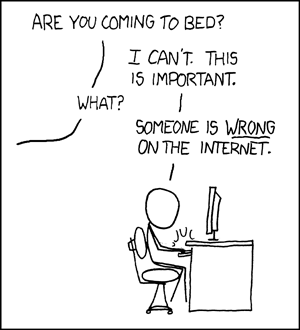
Also, thanks so much to xkcd's Randall Monroe for the totally appropriate comic to use.

Update: Duh. I knew I'd forgotten something. I've added it, reduced Apple vs. PC to runner up, and reorganized an issue that I think was misplaced in the order.

10. Star Trek vs. Star Wars.

A contentious battle rages between fans of Star Trek and Star Wars as to which universe could beat up the other universe. As a geek it should be obvious that they aren't easily comparable, but that doesn't stop them. Oddly, since the fan base overlaps to a wide degree, you'd think that most fans would be able to find some common ground and sit around and watch the shows that they love on an alternating basis.

Hardly. Just like sports fans, geeks have a massive set of numbers, statistics, off hand comments and other trivia with which they can wage month long vicious battles that set friend against friend. Their contests are merciless.

Unlike some of the later examples of flamewar subjects, Star Wars vs. Star Trek flamewars tend only to happen when there are deliberately provoked. Many Star Wars of Star Trek threads continue without issue and only deteriorate when deliberate comparisons are drawn with the opposing franchise.

Considering the viciousness, it's worth pointing out that the two intellectual properties were developed with wildly different intentions and themes. Star Wars is more closely related to an epic fantasy than the optimist futurism of Star Trek. Star Trek endeavors for a realistic future feel and offering commentary on real social situations and technology while Star Wars is meant to be entertaining and flashy and impressive.

That means that most Star Wars ships will win in a fight. As long as you ignore the Borg.

9. Circumcision.

If you've never been involved in a circumcision flamewar, consider yourself lucky. They are surprisingly heated ordeals in which cut men and "nice, all-American" girls argue for circumcision ("I just like the way that it looks" and "they're normal") against uncut men and "sluts" who argue against it ("It feels better" and "It's more fun"). It doesn't help matters that both sides also have well-intentioned authoritative supporters: nurses are often against the procedure and AIDS researchers are for it.

Many nurses apparently often argue that not only is it cruel and painful to the child but that it's a risky cosmetic procedure done without the informed consent of the patient. On the other hand studies in Africa have indicated that there is a reduction in the chance of HIV transmission for men that are having unprotected sex if they are circumcised.

There are second level arguments on both sides. Proponents will argue that it's a fairly safe and approved cosmetic procedure that normalizes the appearance of the penis. Those against it point out that condoms are many times more effective at preventing HIV transmission than circumcision.

Usually when circumcision threads show up they seem harmless at first. After all, compared to abortion most people wouldn't consider circumcision a big deal. However due to it's popularity in America, and the fact that men feel attached to what happens to their penises, a lot of people have developed strong feelings for or against the procedure. A few words about one person's uncut penis as opposed to what another person did to their kids and those strong feelings can erupt in a heated manner.

8. The War in Iraq (and Terrorism).

Although they have produced a lot of rhetoric and name calling, the war flamewars are surprisingly tame when it comes to a fundamental level. After all, most people seem to agree on the basics: winning, supporting the troops, and defeating the terrorists are good things while losing and getting attacked on American soil are bad. If you agree on so much, there's really only the minutia to fight over before the argument moves on to something else.

Basically, what these flamewars tend to do is drastically distort people's actual positions to produce controversy, or devolve into personal competency arguments involving politicians (which results in a Dem vs. Rep flamewar, see #2). This means that while the words thrown back and forth are heated, they don't seem to score as many hits as more vitriolic flamewars.

While the best war flamewars will be partisan, you can also get minor flamewars wherever someone suggests a specific strategy.

The major exceptions to the war flamewar as outlined above are those that erupt between those people that want to examine why the terrorists hate us, and those that think that ascribing human reasoning to terrorists is somehow material help to those terrorists. I've never understood why a minority of people believe that talking about the history of the Mideast is somehow problematic. These people can make war flamewars especially vitroilic but have been mostly shouted down recently, lowering the subject of the war one or two notches down this list.

7. Gay Marriage.

The general agreement among the largest number of people is that the government shouldn't be involved in marriage, just in granting civil unions. Since civil unions aren't "marriages" then religious people don't care if the government gives them to homosexuals and homosexuals and their allies don't feel like they're getting the short end of the stick.

The problem is that the government is deeply involved in "marriage." It exists in the tax code, in state constitutions, in inheritance law and all other sorts of crazy legal facets. It's really hard to change. Additionally, there's a minority on both sides that really want the word "marriage" to continue to be administered by the government because they think that the changes will suddenly render their relationships loveless. Or something.

Thus, the gay marriage flamewar is born. Even though there seems to be a fairly reasonable middle ground, the people on the fringe keep everyone else from getting close to some sort of agreement on the issue.

Often there's a religious undertone to gay marriage flamewars, which provides a little extra fuel for the fire, and allows for all sorts of "Leviticus 18:22" one liners to commonly appear. Sometimes someone will claim that if gay marriage is legalized their personal church will be forced to perform the services (although this idea is patently ridiculous).

Interestingly, although gay marriage can result in some very large flamewars, they typically only erupt around major announcements, like a judges ruling or a major statewide vote. There's a certain "gay marriage" critical mass required before the sparks really start to fly but once it's reached things heat up quickly.

6. Gun Control vs. Gun Ownership

I don't think there's another issue on this list, with the possible exception of the first place finisher, in which the opposing sides spend so much time ranting about things that their opponents are not saying. Each side constructs elaborate straw men that have nothing to do with their actual position on the issues that matter, and then foam at the mouth about them.

It doesn't help that the Second Amendment is out of date. Militias? Nobody today is in a militia, so what does that amendment even mean? But most gun control advocates are not advocating taking people's guns away from them (notice the key word "most") and most gun owners are in fact law abiding citizens that arm themselves for personal, family, and social protection.

Thus, you have the people that are pro-gun control and the people that are gun owners.

Never the twain shall meet in polite discourse.

You'd think that since this amendment was part of the original bill of rights, it would have become a quiet academic concern. Instead, a mention of gun control or a particularly violent killing (usually in Texas) can spawn a horrific flamewar about this subject.

5. Free vs. Regulated markets.

A laissez-faire system will result in untold wealth for everyone, says the free market enthusiast. Except that corruption, croynism and class stratification will occur, so economic systems have to be closely controlled, retorts the market regulator.

Although addicting, emotional, and interesting, this central battle of economics has never been resolved. There really has been no workable anarchist economic system feasible to give the Objectivists their try, and attempts at incredibly restrictive economic conditions have mostly failed.

A capitalistic mix seems to work well, but no two people seem to agree on exactly where the line should be drawn. The economic conservatives today suggest that the current economic problems are the result of over regulation of industry, and the economic liberals see it as the opposite. Since economics is more closely related to palmistry than a statistically rigorous science, no one knows who is correct.

It doesn't help that the issue is closely related to the existence of social programs. The libertarians find it unfair that they have to support those that have failed and the bleeding hearts find it unacceptable that we would allow people to starve or freeze due to market conditions.

Thus, the major divide in economics continues to provoke flamewars.

4. The Existence of God.

Considering that this question attacks the very fundamental nature of the reality in which people live, it isn't surprising to me that people feel so strongly about the subject that they're willing to lay out everything they can to either rally support or attack the other side.

Another sticky issue is that neither side can actually prove it's case, resulting in long frustration for both sides, who often end up lost in tiny bits of minutia or at a dead end when a believer says "Because I have faith" or an unbeliever says "Prove it."

Although there are specific instances in which the flamewar is based on a particular provocation (like a Richard Dawkins letter to the Times), this is a flamewar subject that doesn't necessarily have to be provoked. A casual mention of God, or an offhand comment by an atheist can sometimes create a flamewar where there was only a peripheral connection before.

Another problem with this kind of flamewar is that it only very rarely strays from certain fixed tropes or one liners. Keep a watch out for the "Problem of Evil," Ockham's Razor, various incarnations of Pascal's Wager, and the Flying Spaghetti Monster.

3. Abortion.

Considering that it is based on a small range of medical procedures, abortion is one of the most contentious of all internet topics. It has spawned entire real world organizations with members numbering in the millions beyond the numerous websites and message boards that some of the previous topics have to back them up.

Basically, the arguments boil down to a question of whether you support murder or slavery, and neither side is willing to accept "no answer" as acceptable.

One of the most interesting things about abortion flamewars is that the implications of each side have real world application. In a world that has banned abortion, you would be either locking women up for the protection of their unborn children or punishing them for getting rid of unborn children. In the current system, hundreds of thousands of what could considered to be lives are being lost. This is an important ethical question that is worth major consideration.

This is basically the "single issue voter" issue, and every election thousands if not millions of dollars are spent over the slightest steps back and forth. There are even linguistic breaks that are used to differentiate the sides and cast each other in a negative light.

Also, even though you'd think that both sides would want to keep the number of abortions down, that isn't always the case. Thus, the abortion question is sometimes related to the question of abstinence and abstinence plus sex ed, which barely missed the cut-off for this list.

Personally, considering the consequences of a person's stance on the position, I do understand why this is one of the big questions facing Americans today.

2. Democrats vs. Republicans.

If there's anything that the two party system has taught me, it is that populations are easily polarized. One of the clearest examples of this is in the virulent hatred of the opposing political parties here in the U.S.

People can't just disagree with each other, they have to stand up to the evil which is the opposing political party.

There are a few exceptions to the rule, a few bipartisan elected officials that do their job well and are widely liked on "both sides of the aisle." However, once on the national stage, they pretty much no longer exist. No matter what they do, they'll be torn down by the opposing side, who doesn't want the other guys to get a political advantage over them.

One of the biggest problems with these flamewars is that there can be no rational discussion. The sides talk past each other and since people personally identify with their parties they are personally hurt when any criticism surfaces.

Then there is the further problem that there are actually (at least) two axises of political thought in the United States, social and economic. Thus, half the time when you are talking to someone of one political party, they will only disagree with you on one axis and not the other. Socially liberal Republicans are tarred with the "right wing anti-choice anti-gay marriage" label and fiscally conservative Democrats are called "left wing 'tax and spend.'" As you can imagine, this can creates bad feelings on both sides, even though by supporting one party or the other you are implicitly endorsing both their economic and social policies.

Political flamewars recently have also seen the rise of the "concern" troll, someone that pretends to be affiliated with a party only to offer backhanded compliments and misinformation. Unlike a normal troll, concern trolls are harder to detect and can gather a substantial backlash on the way to a flamewar. While usually these types of trolls would be used to mock the opposing side, in the political arena they can actually rise to national and political prominence.

It also helps that many people strongly identified with parties are also incredibly divisive. George W. Bush, Bill Clinton, Dick Cheney, Nancy Pelosi, Karl Rove, Ted Kennedy, and Rick Santorum are all easy ways to lead into a political flamewar. Sometimes an individual figure can kick off a Dem vs. Rep flamewar by themselves, such as the way that Sarah Palin recently has been able to do or George W. Bush managed for years by himself.

Sometimes the best Democrat vs. Republican flamewars merge with one of the previous flamewar subjects to create a super flamewar (although usually not "Star Trek vs. Star Wars"). After all, if you've got the above mentioned controversial figures to point to during a flamewar about economics, you can anger more people at once. And find a way to bring in abortion. And dis circumcision.

One of the only problems with political flamewars is that they're one of the few kinds of debates that can get over saturated and lose their focus. So much political stupidity can happen in a single day that people won't know which thread to post in. Sometimes instead of one daily political flamewar there will be a slew of smaller ones that don't get nearly as vicious and tend to peter out quickly.

1. Evolution and Creation.

Absolutely the top of the pile for utter raving insanity, the debate between evilutionists and creatards is the current major battlefield between science and religion and the only thing capable of overthrowing political parties as the best flamewar subject. Nothing seems to bother the deeply religious more than an insinuation that we might not be the result of God's plan and nothing seems to bother the scientific community more than the insinuation that their years of study and careful examination are wrong because an old book says so.

Thus, the best flamewars are born.

Considering that unlike presidential or party politics the vocal supporters of creationism are a minority in the U.S., it would be easy to assume that this flamewar doesn't get much play, but nothing seems to provoke a flamewar faster. After all, both sides believe that they have the "truth" and there doesn't seem to be a quicker way into the heated flames of online battle than that.

Interestingly, unlike the Existence of God flamewars mentioned above, the existence of actual evidence does nothing to reduce anger and force with which these arguments are put forth. In fact, I would argue that it increases it. While the question of the existence of God is something of a stalemate, the debate between creationism and evolution has become a question of "Who do you trust?"
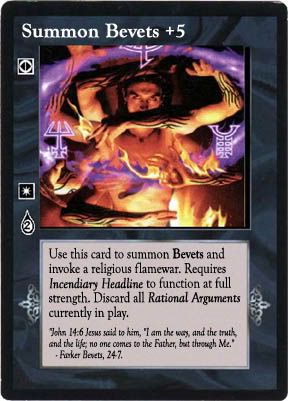
Specifically, evolution and creation flamewars are the nexus of debate between fundamentalist Christianity and atheism, even more so than the Existence of God. While the middle of the road might argue about the existence of God, the extremists are the ones that argue creation and evolution. Added to that are the examples of Richard Dawkins and PZ Myers, biologists and atheists that characterize the evolution supporters that have become famous in their own right for their outspoken opinions on this particular topic. As a farker, there are a couple of notable creationists as well. No, I'm not talking about Michael Behe or Kent Hovind but Bevets, the oft summoned indicator of a true Fark evolution/creation flamewar.
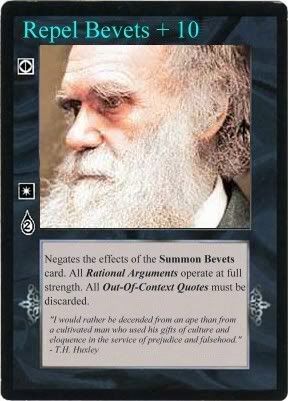
Probably the most legendary troll on Fark, it's hard to think of another internet user that is as defined by a particular subject more than Bevets and his creationism. Possibly Scalzi and bacon, but I doubt it. Almost without a subject break in years, Bevets is the tireless apologist for creation, even going so far as to host his own website with common arguments so that he can throw up links to longer rants without needing to retype them. Granted, there are sites like TalkOrigins that refute him, but Bevets does his long and exhaustive work on his own, thus earning him recognizable card game adaptations on Fark.

These debates also led to one of my favorite eponymous law: Poe's Law, which basically states that it is nearly impossible to determine the difference between a parody and a true believer. Although born in the evolution/creation debates, I've found Poe's law useful in other arenas (particularly politics).

Creation/evolution flamewars can be started over the smallest provocation. A mention of a 40 million year old fossil will sometimes provoke one, as can articles on geology, epidemiology, genetics, Mideast history or even meteorology (see vapor canopies). Then there are the subjects that can suddenly morph into creation vs. evolution debates. For example, someone arguing about the existence of god/God might use evolution or creation of proof of one of the positions. The same with the inerrancy of the bible, or carbon dating, or even a discussion of different scientific theories. If you accidentally mention that the cute kitten in the photoshop contest evolved you might have a flamewar on your hands.

Of course this is in addition to the multiple creation museum articles, advances in evolutionary biology and school board "teach the controversy" or evolution banning threads that seem to appear on a weekly basis.

Considering the nearly one hundred and fifty years that these debates have been raging, not to mention the entire religions and governments that have weighed in, this is also a historically weighty flamewar. Mentions of Darwin (both as evidence for the science supporters and as a "Darwinist" insult from the religion supporters) and shepherds that have been dead for 2000 years (mostly as an insult to Biblical literalists) abound.

Finally, I'll end on a high note and point out that it's fairly easy to Godwin a creation/evolution flamewar. After all, the Nazis were evolutionists, no?


The runner up subjects were sex education in schools, various sports team rivalries, "activist judges" (i.e. rulings that we don't like), and breastfeeding. Yup. Breastfeeding. You'd be surprised.

The Honorable Mention is:

Apple vs. (Microsoft) PC.

Starting the list off is one of the most pointless debates that I can think of, yet one that manages to devolve into a name calling match most times it appears. Any time there's a comparison of some kind between Mac computers and PCs, there's always some people that feel the need to belittle people that don't own the same sort of computer that they use.

This is partly due to the Apple marketing campaign which goes to such great lengths to establish the duality of the products and promote their brand as the hip and cool alternative. This does overlook the fact that they are a niche family of products, and even if they could compete with the wider PC market, doing so would probably drag them down to encompass some of the same problems that PCs embody.

Additionally, then there's the Microsoft angle, in which people get to hate on Microsoft. Unfortunately, in this monopoly of hatred, there isn't another company that can take on a serious mantle of opposition to the mighty "M$" more than Apple, and so Apple receives the bulk of the attention. The real rivals to most Microsoft products are unknown to the bulk of Americans, and thus invisible during the flamewars between Apple fanboys and Microsoft drones.

Thanks to the long term "We're better than they are" campaign run by Apple, these flamewars have been surprisingly persistent.

Labels: , , , ,

Thursday, April 10, 2008

Ad Hominem Behind Someone's Back

Scalzi gave a platform to Vox Day, and Chad Orzel got upset with him for doing so.

In one of the comments (#88), MikeT says that

Chad should be ashamed of himself for writing a seven paragraph long post that is almost entirely ad hominem, and that doesn't even take a stab at proving why Vox is a "poopyhead" for making his arguments...

Now, I obviously used to spend a lot of time at a website where ad hominem was not allowed, and edited whenever seen. For most of my time there, it was my job to edit it. However, I don't always think that all ad hominem is necessarily immoral, bad, or even incorrect.

The problem is that I've seen examples of people consistently unable to address arguments against them. Peace girl, or whatever her name was at IIDB, was sure that she'd found the true secret to universal happiness which basically boiled down to: Everyone should ignore the bad things that they see, because if they pretend not to see them and do good things, everything will become perfect.

Yeah, if that was possible for everyone to overlook bad things to happen, it might make it easier to live on this planet (probably not perfect, bad things will still happen), but unfortunately the implementation of that is utterly impossible.

And over the course of months and thousands of posts, Peace girl just couldn't understand the arguments against her. At all. She was so utterly sure that she was right that her sense of logic and her common sense were swept away. Folie à deux, in her case.

She was wrong though. Her perfect solution depended on convincing everyone on earth that her ideas were just as perfect as she thought they were, despite the flaws and the misconceptions and the just pure wrong facts (she thought that since c was a universal constant, it meant that what we see has no time delay to it, that visible light traveled instantaneously). She didn't understand that people can't just accept that people wouldn't and couldn't accept her mentor's theories. She didn't understand that some people would look for ways to take advantage of believers and only pretend to convert if they felt it was in their best interest.

If I could have gotten Peace girl to reconsider her opinion through ad hominem attacks on her, I probably would have done it myself.

After a few days it was pointless to argue with her but people kept trying, remaining remarkably civil in their attempts to convince a mule to dance for months at a stretch.

Specific to the case of Peace girl is the fact that she was engaged in behavior that was couched in the most polite possible terms, but with the rudest possible intent: she wanted to convert people.

So people argued with her for months, trying to convince her that most people were rational enough to realize that there were so many flaws in her plan that it was impossible to make real. Eventually people did issue attacks against her, and I empathize with them.

Ad hominem attacks are what happens when someone reaches the end of their ability to argue coherently. Sometimes people go to it quickly because they are poor advocates for their position or their arguments suck. After a long, long time of valid arguments that are constantly ignored and dismissed out of hand because of deeply held irrational beliefs, sometimes even the best of us do it.

Orzel calls Day a lunatic. That's his opinion, and from what I see Orzel isn't the type of person to call someone that lightly.

I think that TheOtherMichael from IIDB is a moron. That's my opinion, arrived at through a long process of examination. I think the same thing about George W. Bush, for the same reason.

My father thinks that Thom Hartmann is a tool. That's his opinion, arrived at . . . uh, based on his assessment of Hartmann's opinion gleaned from a few minutes of radio exposure.

I can't say that I agree with Orzel yet, but if the faithful pack of Day supporters that shows up whenever his name is mentioned is any clue, then I suspect that Orzel's not completely out of line for having dropped the logical arguments in favor of the ad hominem attacks.

He's just tired of saying things that are ignored.

Labels: , ,

Tuesday, May 01, 2007

Omelas

Are you familiar with Omelas? It's an interesting place. I hear the architecture is something special.

If you aren't familiar with Omelas, you should be. Read the short story by Ursula Le Guin here:

The Ones Who Walk Away From Omelas

I happen to think that it's one of the most brilliant short stories ever written. I've cried several times after reading it and then coming back to it later. I can't describe how powerful a short story without characters or a plot can be, but this is one of the most moving pieces of writing that I've ever read.

I've been obsessing over Omelas recently in regards to one of the websites that I belong to, CF. There's no child at CF, but that doesn't mean that the parallels, the aspiring perfect society with deep underlying flaws aren't comparable.

I've been thinking about it a lot. There are those that live in Omelas, those that walk away from Omelas, and there is a third group: those that stay and try to rise in society to the point where they can open the door and release him.

Only those that walk away are without blame. They're stronger than I am. I would be in the third group, if I was a person. I'm not. I'm a non person. Nothing more than a watcher.

That isn't depression talking. That's an accurate description of my place at CF. It's an odd place.

I know there wasn't a Lex and Lia this week. Sorry, I need to take a break for a week, but I promise that it will be back next week. I'm also going through a dry patch with other blog posts, so I wanted to apologize for that as well.

Labels: , , , , ,

Saturday, April 21, 2007

Morality on Sale

Morality isn’t cheap.

The current Administration has made our morality something to be discounted. If supporting the President is the moral thing to do, that is relatively easy and inexpensive. It doesn’t require much time, thought, or money: All you need is a yellow ribbon car magnet.

Morality must happen on a higher level. Morality demands that sometimes we not offer the contract to the lowest bidder.

Sometimes, morality even demands that we not vote for the candidate offering us the lowest taxes.

I don’t want to mince words here: when a Republican says that he will tax you less than a Democrat, he’s rarely offering you something moral. He’s offering you something that is personal and appeals to your self-interest, and self-interest rarely leads to a moral choice.

Instead of lower taxes, he should be offering you a smaller, more efficient government. If he can manage to do that and still maintain the services that affect you directly, then taxes will go down. It won’t happen instantaneously, either. Morality isn’t quick.

The Republicans aren’t currently doing that though. They’re supporting a distant and expensive war. They’ve overseen the largest expansion of government in recent times through the creation of the Homeland Security department. They’ve been offering their girlfriends fifty thousand dollar raises. They were probably doing the same thing back when they controlled everything, except they probably weren’t getting caught.

What bothers me is that some people will continue to vote for the Republicans because the Republicans have entrenched themselves with the religious right. The issues of gay marriage and abortion are more powerful than the issues of feeding the poor and behaving ethically (I’ll leave the Christians to discuss which of those issues Jesus thought were so important that they became themes in the bible).

Yes, I’m sure that these people simply can’t vote for the Democrats because if they vote for a person that endorses sin in the form of abortion or homosexuality they will be cast down into hellfire and tortured eternally. However, those people should have realized by now that if they vote for the Republicans they are supporting war, poverty, lying, and corruption. What do you think Jesus will say about that? Politics is not black and white. If you believe that we’re “evil” that doesn’t make the people that disagree with us “good.”

I’m sorry that you don’t have a perfect and sinless political party. Unfortunately you have two imperfect facets of the same stone, and if you don’t want to “support sin” then you shouldn’t vote at all because democracy leads to hard choices and you will always end up supporting something that you don’t like along the way.

I understand that when I vote for a Democrat, my taxes will probably go up. The Democratic Party shouldn’t shy away from that. They should point it out and proclaim from the rooftops that they are bringing morality back to the White House. They should talk about the fiscal responsibility and the morality of doing what is ethical instead of what is quick and cheap.

Morality instead of convenience is a good thing in my book.

Labels: , ,